
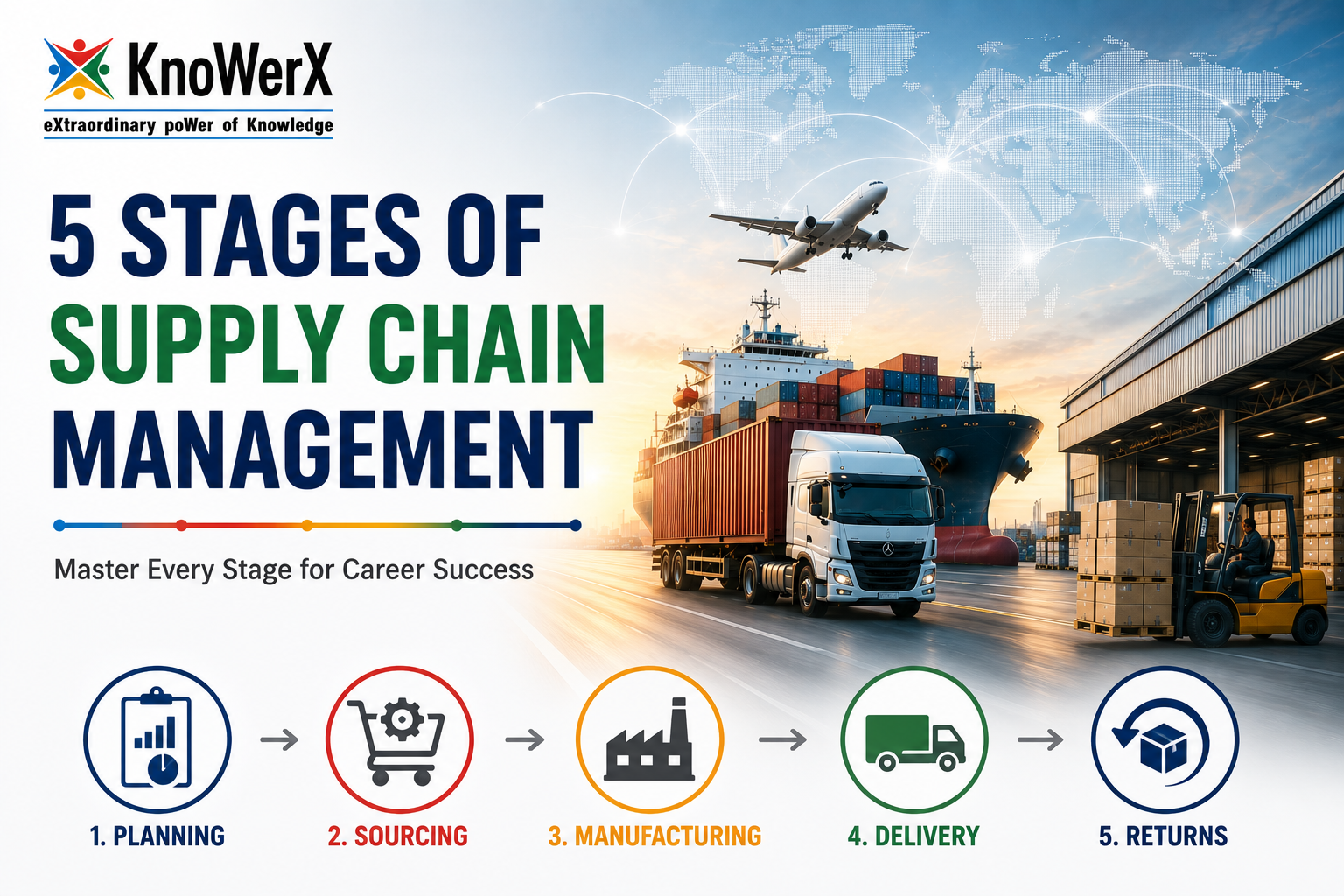
5 Stages of Supply Chain Management | Master Every Stage for Career Success

Every product that reaches a customer passes through a series of interconnected processes before it arrives. These processes, collectively known as the stages of supply chain management, represent the full journey from raw material sourcing through to the moment a product is delivered and, if necessary, returned. Understanding these stages is foundational for any supply chain professional, not just as academic knowledge but as a practical framework for identifying where value is created, where inefficiencies exist, and where improvement efforts will deliver the greatest impact.
What Are the Stages of Supply Chain Management?
The stages of supply chain management refer to the sequential phases through which goods, information, and finances flow as products move from their point of origin to the end customer. Whilst different frameworks use different terminology, the five core stages of supply chain management are universally recognised across industries: planning, sourcing, manufacturing, delivery, and returns.
Each stage has its own distinct set of activities, responsibilities, and performance metrics. Each also depends on the stages before and after it meaning that a weakness at any single stage has the potential to affect the performance of the entire chain. This interdependence is precisely why a holistic understanding of all five stages of supply chain management is so valuable for professionals working anywhere within the supply chain function.
The stages of supply chain management are not simply operational checkpoints. They are strategic levers. Organisations that understand and optimise each stage consistently outperform those that manage individual functions in isolation, delivering better customer outcomes, lower costs, and greater resilience in the face of disruption.
Stage 1: Planning the Foundation of an Efficient Supply Chain
Planning is the first and arguably most critical of the five stages of supply chain management. Everything that happens downstream sourcing decisions, production schedules, inventory levels, and delivery commitments is shaped by the quality of the planning that precedes it.
Demand Planning and Forecasting – At the heart of the planning stage is demand forecasting: the process of estimating future customer demand using historical data, market intelligence, and statistical modelling. Accurate demand forecasts allow organisations to align their supply plans with anticipated customer requirements, reducing the risk of both stockouts and excess inventory.
Sales and Operations Planning – Sales and Operations Planning, commonly known as S&OP, is the cross-functional process that translates demand forecasts into integrated supply, production, and financial plans. Effective S&OP ensures that all functions within an organisation are aligned around a single, agreed plan reducing the miscommunication and misalignment that often leads to inefficiency across the later stages of supply chain management.
Inventory and Capacity Planning – Planning includes making choices about how much inventory to keep and how much production capacity is needed. Figuring out how much stock to keep, where to store it, and how much space to set aside needs a close look at changes in demand, delivery times, and the balance of costs. Making mistakes at this point can be expensive and hard to fix after production and sourcing agreements are in place.
Stage 2: Sourcing
Sourcing is the second of the stages of supply chain management and covers the processes involved in identifying, evaluating, and managing the suppliers who provide the raw materials, components, and services required for production.
Effective sourcing goes well beyond finding the lowest-cost supplier. It involves assessing supplier reliability, quality standards, financial stability, and ethical compliance, as well as negotiating contracts that protect the organisation’s interests whilst building productive long-term relationships. Supplier diversification maintaining relationships with multiple suppliers for critical inputs is an increasingly important sourcing strategy for organisations seeking to reduce supply chain vulnerability.
Strategic sourcing decisions made at this stage directly affect quality, cost, and continuity across all subsequent stages of supply chain management. A poorly qualified supplier or an over-concentrated supply base creates risk that no amount of downstream efficiency can fully offset.
Stage 3: Manufacturing

Manufacturing is the third of the stages of supply chain management and encompasses the conversion of raw materials and components into finished goods. It includes production planning and scheduling, materials requirements planning, capacity management, quality control, and shop floor execution.
The manufacturing stage is where the inputs obtained through sourcing are changed into the outputs that customers eventually buy. At this point, how well things work relies a lot on how precise the plans made earlier are and how dependable the materials obtained are. Any problems that occur in the earlier stages of supply chain management will definitely impact manufacturing performance, no matter how well the production process is handled.
Lean manufacturing principles, quality management frameworks, and continuous improvement methodologies all have their primary application at this stage, helping organisations reduce waste, improve throughput, and maintain consistent quality across production runs.
Stage 4: Delivery
The delivery stage covers the movement of finished goods from production facilities through distribution networks to the end customer. It encompasses warehousing, order management, transportation planning, and last-mile delivery the final link between the supply chain and the customer experience.
Of all the stages of supply chain management, delivery is often the most visible to customers. Late deliveries, incorrect orders, or damaged goods directly affect customer satisfaction and brand reputation in ways that upstream failures typically do not. This visibility makes delivery performance one of the most closely monitored aspects of supply chain operations, with metrics such as on-time delivery rates, order accuracy, and delivery lead times tracked consistently across industries.
Distribution network design decisions about where to locate warehouses, how to route shipments, and which logistics partners to work with has a significant impact on both the cost and the speed of delivery. Organisations that invest in optimising this stage of supply chain management typically see improvements across all three dimensions: cost, speed, and customer satisfaction.
Stage 5: Returns
Returns, often referred to as reverse logistics, is the fifth and final of the stages of supply chain management. It covers the processes involved in receiving, inspecting, and managing goods that customers return, as well as the disposal, refurbishment, or redistribution of those goods.
The returns stage is often under-resourced compared to its strategic importance. A good returns process protects customer relationships, recovers value from returned goods and provides data that can be used upstream to improve quality and demand planning. As sustainability expectations rise and the principles of the circular economy become more mainstream, organisations are increasingly looking at the returns stage as a source of competitive advantage, rather than just an operational cost.
Why Optimising Every Stage of Supply Chain Management Matters
The five stages of supply chain management are not independent processes they are deeply interconnected. A demand forecast that is inaccurate affects sourcing decisions, which affect production schedules, which affect delivery performance, which affect customer satisfaction. Optimising one stage in isolation without considering its impact on the others rarely produces the sustained improvement that organisations are looking for.
The most effective approach to supply chain improvement is therefore an integrated one understanding how decisions made at each stage affect the performance of the chain as a whole, and using that understanding to identify where intervention will deliver the greatest benefit. This integrated perspective is precisely what distinguishes strategic supply chain thinkers from purely operational ones, and it is the perspective that professional certification programmes are designed to develop.
Organisations that consistently outperform their peers do so not by excelling at one or two stages of supply chain management but by building capability and visibility across all five. They invest in planning accuracy, supplier relationships, manufacturing efficiency, delivery optimisation, and returns management simultaneously, recognising that the chain is only as strong as its weakest link.
Frequently Asked Questions
What are the five stages of supply chain management?
The five stages of supply chain management are planning, sourcing, manufacturing, delivery, and returns. Each stage has its own distinct activities and performance metrics, and all five are deeply interconnected meaning that performance at one stage directly affects the others.
Why is the delivery stage so important to customer satisfaction?
Delivery is the most visible of the five stages of supply chain management to customers. Late deliveries, incorrect orders, or damaged goods directly affect customer satisfaction and brand reputation. On-time delivery rates and order accuracy are therefore amongst the most closely monitored metrics across supply chain functions.
What is reverse logistics and why does it matter?
Reverse logistics, or the returns stage, covers the processes involved in receiving, inspecting, and managing returned goods. An efficient returns process protects customer relationships, recovers value from returned products, and provides data that can improve quality and planning accuracy upstream. As sustainability priorities grow, returns management is increasingly recognised as a strategic capability.
Ending Notes – Build Expertise in Supply Chain Management
Understanding the stages of supply chain management is the starting point for building genuine supply chain expertise. For professionals who want to go deeper developing the applied knowledge, analytical frameworks, and strategic perspective that drive real improvement structured learning and professional certification provide the clearest path forward.
Certifications such as the CPIM, CSCP, and CLTD from ASCM are structured around the full breadth of supply chain knowledge, covering all five stages of supply chain management in depth and equipping candidates with the tools to analyse, improve, and lead supply chain operations at every level.
At KnoWerX, we have spent 34 years helping supply chain professionals build the expertise they need to perform at their best across every stage of supply chain management. Our instructor-led programmes combine official ASCM learning materials with practical, scenario-based teaching to ensure that every candidate develops not just knowledge but the ability to apply it. If you are ready to deepen your understanding of supply chain management and advance your career, we would be glad to support your journey.
Image Reference: Magnific
Disclaimer: All trademarks, logos, and brand names are the property of their respective owners. All company, product, and service names used in this website are for identification purposes only. Use of these names, trademarks, and brands does not imply endorsement.