
CPIM Exam Modules | Master All 9 Modules With Confidence | KnoWerX
For a supply chain professional, obtaining the CPIM certification is generally regarded as one of the most credible ways to prove competency in internal operations. But one of the most common questions candidates ask before signing up for is a simple one what does the exam cover? Knowing the CPIM exam modules is not enough before you start to study. It is a practical advantage that will affect how you plan your preparation, how you spend your time, and how you approach the exam itself.

Understanding the CPIM Certification and Its Exam Structure
CPIM (Certified in Planning and Inventory Management) is a certification offered by ASCM and is globally accepted as a standard benchmark qualification for professionals involved in the planning and inventory management side of production and supply chain operations. The assessment is designed to demonstrate the candidate’s understanding of the theory of supply chain management and their ability to apply best practices to the internal operations of an organisation.
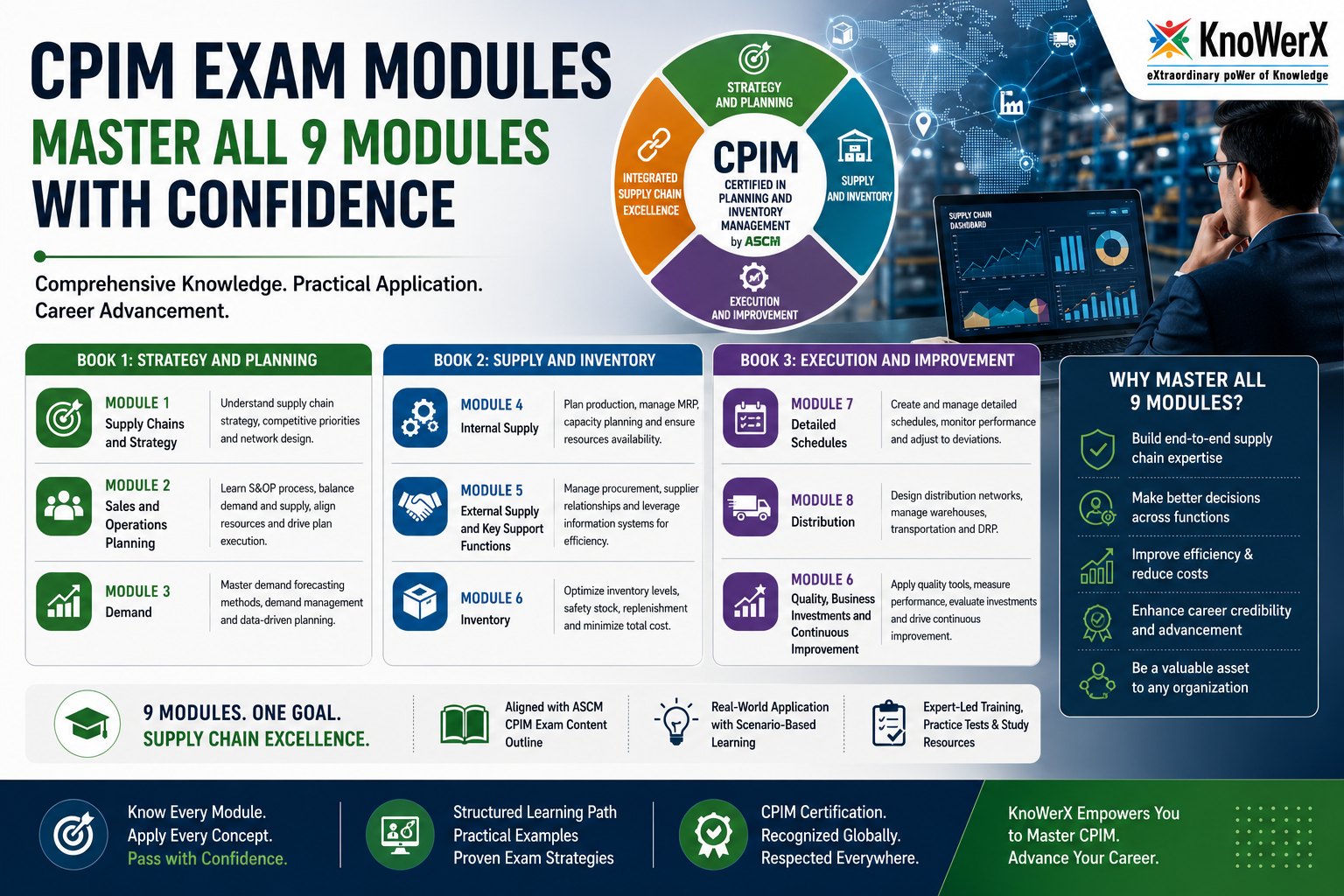
The CPIM exam is divided into three books containing nine modules each. Each module covers a different aspect of supply chain knowledge and together they provide a complete picture of how effective planning and inventory management works in practice. Candidates are evaluated on their comprehension, application, and synthesis of concepts across all nine CPIM exam modules, necessitating comprehensive and consistent preparation.
Book One: Strategy and Planning
Module 1: Supply Chains and Strategy
The first of the CPIM exam modules establishes the strategic foundation for everything that follows. It explores how organisations position themselves within the wider supply chains, the link between business strategy and supply chain strategy, and how strategic decisions impact operational performance. Candidates explore ideas such as competitive priorthe design of supply chain and aligning supply chain capabilities with organisational objectives.
Module 2: Sales and Operations Planning
Sales and Operations Planning, commonly known as S&OP, is the process that connects strategic intent with operational execution. This module examines how organisations balance supply and demand across the medium-term horizon, how cross-functional collaboration supports effective planning, and how the S&OP process helps businesses respond to changes in market demand while managing capacity and resources efficiently.
Module 3: Demand
The third module of the CPIM exam is demand management and forecasting. Candidates study different forecasting techniques, the factors that influence demand variability and how organisations use demand data to inform planning decisions. The ability to read and respond to demand signals is relevant to many areas of supply chain practice, and therefore this module is particularly useful for applied exam questions.
Book Two: Supply and Inventory
Module 4: Internal Supply
This module shifts focus to the production side of the supply chain, covering master scheduling, material requirements planning (MRP), and capacity management. Candidates learn how organisations translate demand plans into detailed production schedules, how MRP systems generate procurement and production requirements, and how capacity resource planning ensures that the right resources are available at the right time.
Module 5: External Supply and Key Support Functions
External supply covers the procurement side of operations, including supplier selection, purchasing processes, and the management of supplier relationships. It also addresses key support functions such as information systems and their role in enabling effective supply chain coordination. This module connects internal planning processes to the external supply base, reflecting the integrated nature of modern supply chains.
Module 6: Inventory
Inventory management is one of the most practically significant of the CPIM exam modules. It covers inventory classification, replenishment methods, safety stock calculations, and the trade-offs involved in managing inventory levels across different supply chain contexts. Candidates must understand the concepts and how to apply them in scenario-based situations, which is the format the exam uses to test this knowledge.
Book Three: Execution and Improvement
Module 7: Detailed Schedules
Detailed scheduling translates higher-level production plans into specific, time-phased instructions for the shop floor. This module examines scheduling techniques, priority rules, and the management of work orders and production activities. It also covers how organisations monitor schedule adherence and respond to deviations in real time, linking planning theory to day-to-day operational execution.
Module 8: Distribution
The distribution module addresses how finished goods move from production through to the end customer. Topics include distribution network design, warehouse management, transportation planning, and the role of distribution requirements planning (DRP) in aligning distribution activities with upstream supply plans. For candidates working in logistics or distribution roles, this module is often one of the more immediately applicable CPIM exam modules.
Module 9: Quality, Business Investments, and Continuous Improvement
The final module takes a broader view, examining quality management principles, performance measurement, and the tools used to drive continuous improvement across supply chain operations. Candidates study frameworks such as total quality management, lean principles, and key performance indicators, as well as how investment decisions in supply chain infrastructure are evaluated and justified.
How the CPIM Exam Modules Build Real-World Supply Chain Skills
One of the most important things to understand about the CPIM exam modules is that they are not isolated academic topics. They are meant to mirror in practice the real interaction of supply chain functions. A production schedule (Module 7) is dependent on a material requirements plan (Module 4), which is dependent on a demand forecast (Module 3), which is dependent on a sales and operations plan (Module 2). All modules are interlinked and the exam will assess a candidate’s knowledge of this interlinkage, using scenario based questions that cross multiple areas at the same time.
This integrated structure means candidates who understand the relationships between the CPIM exam modules are much better prepared for exam day than those who study each topic in isolation. This also means the learning they prepare for is directly relevant and applicable to the supply chain roles candidates currently perform or hope to pursue.
Tips to Prepare for All 9 CPIM Exam Modules
Start with the exam content outline. Before opening any study material, review the official ASCM content outline for each of the CPIM exam modules. This shows you which topics are most important and helps you prioritise your preparation time.
Study modules in sequence. The three-book structure is deliberate. Modules build on each other, and studying them in order helps candidates develop a logical, integrated understanding rather than a fragmented one.
Use active recall from the start. After studying each module, test yourself with practice questions before moving on. This reinforces learning in real time and reveals gaps while there is still time to address them.
Schedule integration practice in the final weeks. As you approach your exam date, practise with questions that draw on multiple CPIM exam modules at once. This mirrors the actual exam format and builds the synthesis skills that scenario-based questions demand.
Revisit earlier modules regularly. Information from the first two or three modules can fade by the time you reach the later ones. Short weekly review sessions keep earlier content fresh and ensure that no module is neglected as the exam approaches.
Why Mastering the CPIM Exam Modules Can Accelerate Your Career
CPIM practitioners consistently report that the knowledge they acquire while preparing for the exam helps them perform better on the exam and in their day-to-day job. Certified professionals who understand how demand forecasting relates to inventory decisions, production schedules, supplier lead times, and quality improvement frameworks across operations will have a broader, more strategic view of their role.
In addition to short-term career advantages like being given more serious consideration for promotions and being eligible for specialist roles, the CPIM certification tells employers that a professional has taken the time to learn about supply chain operations in a way far beyond on-the-job experience. That difference matters in a competitive job market.
Passing the exam is not simply a matter of knowing the nine CPIM exam modules. It’s about building a holistic and pragmatic understanding of supply chain operations that enable better decisions, better performance and sustained career growth.
Frequently Asked Questions
What are the 9 CPIM exam modules?
The nine CPIM exam modules are Supply Chains and Strategy, Sales and Operations Planning, Demand, Internal Supply, External Supply and Key Support Functions, Inventory, Detailed Schedules, Distribution, and Quality, Business Investments, and Continuous Improvement.
How are the CPIM exam modules structured?
The nine modules are organised across three books. Book One covers strategy and planning, Book Two addresses supply and inventory, and Book Three focuses on execution and continuous improvement. Each book builds logically on the one before it.
Which CPIM exam module is the most challenging?
Candidates commonly find Inventory (Module 6) and Internal Supply (Module 4) amongst the most challenging, as both combine conceptual understanding with numerical application. Demand (Module 3) is also frequently cited as difficult due to its focus on forecasting and variability.
Ending Notes
At KnoWerX, our CPIM preparation programmes are structured around all nine modules, combining official ASCM learning materials with instructor-led guidance and scenario-based practice to ensure that candidates are fully prepared for every area of the exam. If you are planning to pursue your CPIM certification, we would be glad to help you build a preparation plan that covers every module with the depth and clarity it deserves.
Image Reference: Magnific
Disclaimer: All trademarks, logos, and brand names are the property of their respective owners. All company, product, and service names used in this website are for identification purposes only. Use of these names, trademarks, and brands does not imply endorsement.