
Significance of Six Sigma | Improve SCM Quality and Performance | KnoWerX
In a profession marked by complexity, variability, and the unending pressure to do more with less, Six Sigma offers supply chain management something really valuable: a structured, data-driven way to cut the process variation that leads to inefficiency, cost, and customer dissatisfaction.

The importance of Six Sigma to supply chain management extends well beyond quality departments and production floors. It applies to every function in the chain, from procurement and planning through warehousing, logistics and supplier management, making it one of the most widely applicable improvement frameworks available to supply chain professionals today.
What Is Six Sigma and How Does It Apply to Supply Chain Management?
The Core Methodology
Six Sigma is a data-driven process improvement methodology that aims to reduce defects, minimise variation, and improve quality to a level where processes produce fewer than 3.4 defects per million opportunities. It achieves this through two primary frameworks: DMAIC Define, Measure, Analyse, Improve, Control for improving existing processes, and DMADV Define, Measure, Analyse, Design, Verify for designing new processes to a Six Sigma standard from the outset.
Why Supply Chains Are Naturally Suited to Six Sigma
Basically , supply chains are a series of linked processes . You can track, analyse and optimise each order fulfilment cycle, each procurement transaction, each warehouse pick and each delivery route. The significance of Six Sigma in supply chain management lies precisely in the congruence between the methodology’s focus on process performance and the process-intensive nature of supply chain operations. Where variation exists in a supply chain process, Six Sigma has the tools to identify it, to quantify it, and to systematically eliminate it.
Why Is Six Sigma Significant in Supply Chain Management?
Reduces Process Variation for More Consistent Operations
One of the most common causes of supply chain underperformance is process variation. When lead times are unpredictable, when order accuracy fluctuates from week to week, or when production yields are different from shift to shift and facility to facility, the entire supply chain must carry more inventory, capacity, and cost as a buffer against that variability.
The importance of Six Sigma in supply chain management is to eliminate this variation at the source. Six Sigma identifies the root causes of process variation and implements controls to keep processes within specified limits. supply chains to operate more predictably reducing the need for the expensive buffers that variability requires and improving performance across every downstream function that depends on consistent inputs.
Improves Quality to Reduce Defects, Errors and Rework
Quality failures in supply chain management are costly far beyond the immediate cost of the defect itself. A defective component identified at goods receipt is expensive. The same component identified after it has been incorporated into a finished product is significantly more so. A quality failure that reaches the end customer carries costs that extend to returns processing, customer service, reputational damage, and potential regulatory consequences.
The importance of Six Sigma in relation to quality in the supply chain management is that it is systematic and root cause approach to defect reduction. Six Sigma builds quality into processes rather than inspecting quality in after the fact, reducing the frequency of defects, errors and rework at every stage of the supply chain from supplier quality through to final delivery.
Reduces Costs Through Waste and Process Inefficiency Elimination
Cost reduction is a constant priority across supply chain functions and Six Sigma is one of the best tools available for achieving this sustainably. Six Sigma reduces costs at the process level, by eliminating the waste caused by defects, rework, excess inventory, unnecessary transportation and over-processing. These savings are durable, because they are built into the way the process works rather than being achieved through one-off negotiations or temporary measures.
From a cost perspective, the importance of Six Sigma to supply chain management is that it links the reduction of costs directly to the improvement of processes. This creates a virtuous cycle; improved processes lead to fewer defects which in turn leads to less rework and waste which reduces costs and frees up resources for further improvement.
Improves Delivery Performance for More Reliable and Predictable Processes
Delivery performance the ability to fulfil customer orders accurately, completely, and on time is one of the most visible indicators of supply chain health. Inconsistent delivery performance almost always traces back to process variation somewhere in the supply chain, whether in planning accuracy, supplier reliability, warehouse throughput, or transportation execution.
Six Sigma is significant in supply chain management because it makes processes more reliable and predictable in the context of delivery performance. When the processes that underpin order fulfilment operate consistently within defined parameters, delivery performance improves as a natural consequence without the need for the excessive safety stock and expediting costs that unreliable processes typically require.
How Six Sigma Supports Strategic Supply Chain Priorities

Enhances Customer Satisfaction Through Better Quality and Service
Customer satisfaction in supply chain management is the cumulative result of quality, reliability, and responsiveness across every customer-facing process. Six Sigma improves all three by reducing the defects, delays, and inconsistencies that erode customer confidence and drive complaint volumes.
The significance of Six Sigma in supply chain management from a customer perspective is that it creates a direct, measurable link between process improvement and customer experience. Organisations that apply Six Sigma systematically across their customer-facing supply chain processes consistently achieve higher customer satisfaction scores, lower complaint rates, and stronger customer retention than those that manage quality reactively.
Supports Data-Driven Decision-Making Across Supply Chain Functions
One of the most important contributions of Six Sigma to supply chain management is its insistence on data. Measurement forms the foundation of every step in the DMAIC paradigm, from defining the problem in measurable terms, through measuring current process performance, analysing data to find root causes, measuring the impact of improvements, and controlling processes through continuous performance monitoring.
This data-driven discipline is directly aligned with the broader shift towards analytics-led supply chain management that is defining the profession in 2026. The significance of Six Sigma in supply chain management in this context is that it provides both the methodology and the cultural orientation needed to make data-driven decision-making a consistent operational practice rather than an aspiration.
Six Sigma Belt Levels and Supply Chain Career Development
From Yellow Belt to Black Belt
The Six Sigma belt structure Yellow Belt, Green Belt, and Black Belt provides a clear progression pathway for supply chain professionals looking to build process improvement capability at increasing levels of depth and responsibility. Yellow Belt holders support improvement projects, Green Belt holders lead them, and Black Belt holders drive strategic improvement programmes across the organisation.
For the supply chain professional, each belt level provides directly applicable skills. Yellow Belt training teaches knowledge of Six Sigma principles and the DMAIC Green Belt training develops the statistical tools and project leadership skills needed to lead improvement efforts within a function. Black Belt training prepares professionals to lead cross-functional transformation programmes and mentor Green Belts across the organisation.
The Career Case for Six Sigma Certification
The significance of Six Sigma in supply chain management extends to career development. Certified professionals consistently demonstrate stronger analytical capability, more structured problem-solving approaches, and a measurable track record of improvement outcomes all of which are qualities that employers across manufacturing, logistics, healthcare, and service industries actively seek in supply chain candidates.
Frequently Asked Questions
What is the significance of Six Sigma in supply chain management?
Six Sigma is significant in supply chain management because it provides a structured, data-driven methodology for reducing process variation, improving quality, eliminating waste, and enhancing delivery performance across every supply chain function from procurement and planning through to warehousing, logistics, and supplier management.
How does Six Sigma reduce costs in supply chain management?
Six Sigma reduces supply chain costs by eliminating the waste generated by defects, rework, excess inventory, unnecessary transportation, and over-processing. By improving processes at the root cause level, it delivers cost reductions that are durable and built into how the process operates rather than achieved through temporary measures.
How does Six Sigma improve delivery performance in supply chains?
Inconsistent delivery performance almost always traces back to process variation in planning, supplier reliability, warehouse throughput, or transportation execution. Six Sigma makes these processes more reliable and predictable, improving delivery performance as a natural consequence without the need for excessive safety stock or costly expediting.
Ending Notes – Building Six Sigma Capability With KnoWerX
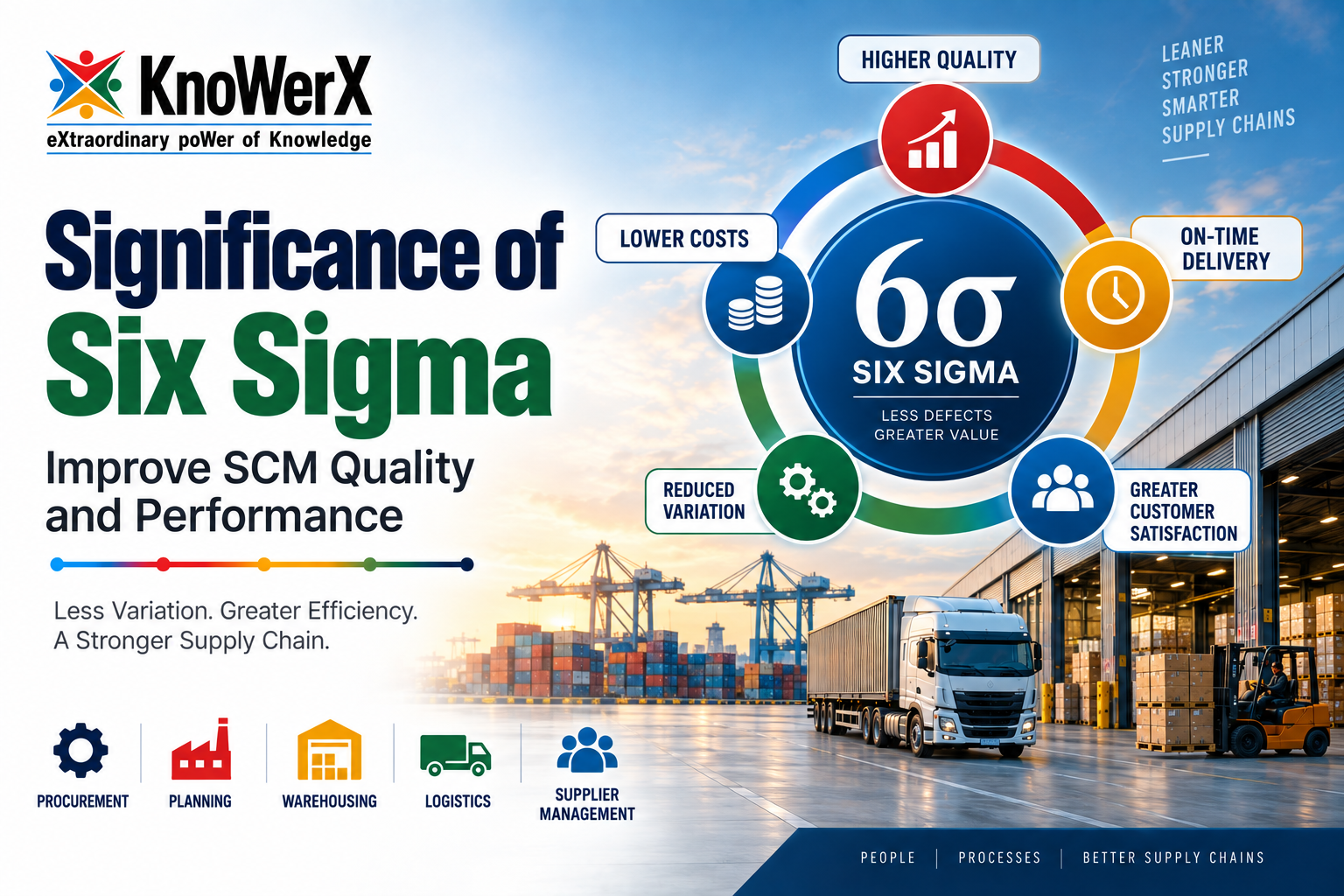
Six Sigma is obviously important for supply chain management – it minimises variation, increases quality, reduces costs, improves delivery performance and encourages the data-driven decision making culture needed by modern supply chains. For supply chain professionals wanting to make good use of this methodology, the most direct route to building real capability is structured training and recognised certification.
Image Reference: Magnific
Disclaimer: All trademarks, logos, and brand names are the property of their respective owners. All company, product, and service names used in this website are for identification purposes only. Use of these names, trademarks, and brands does not imply endorsement.