
CPIM Exam Day Tips | Walk In Confident and Fully Prepared | KnoWerX

For many candidates, the final stage of CPIM preparation is more daunting than the study phase. Knowing the material is one thing, knowing what really happens on exam day is another. One of the most practical CPIM exam day tips any candidate can act on is to know the entire experience ahead of time, from the hours before you leave the house to the moment your result pops up on screen. It erases the unknown, it diminishes anxiety, and lets you focus all your attention on performing to your highest level.
What to Expect on CPIM Exam Day
The CPIM exam is conducted through Prometric in authorised test centres worldwide. Candidates are required to bring valid government issued photo identification to the exam that matches the name on their exam registration exactly. If there is any mismatch between your ID and your registration details, you may be turned away, so it is important to check this well in advance.
Show up at least 15-30 minutes before your start time. This allows for the check-in process without putting pressure on what is already a demanding day. Normally the check-in process includes a digital signature, photo and palm vein scan for biometric verification. You will need to leave all personal belongings – mobile phones, bags, wallets, any notes you may have to study for the test etc in a locker that the test centre will provide for you. Personal items are not allowed in the testing room.
When you arrive, a staff member will escort you to your assigned workstation. You will be given a whiteboard or scratch paper to work out questions on and the exam will be loaded on the screen and ready to go when you start. The test environment is quiet and supervised. Other candidates are working at their own stations at the same time.
The CPIM exam has 150 questions which you need to answer in three and half hours. All questions are multiple choice with four options to answer for each question. The CPIM examination covers all nine modules and tests knowledge of individual topics and the ability to apply concepts in integrated, scenario-based situations. Candidates should also know that a portion of the 150 questions are not scored as they are pilot questions to be used by ASCM to assess future exam content. On the exam these questions are not graded so that each question should be treated with equal care and attention.
How to Prepare in the Final 24 Hours Before the Exam
The 24 hours before your CPIM exam are not the time to introduce new material. Attempting to absorb fresh content at this stage rarely improves performance and can increase anxiety by highlighting gaps that there is no longer time to address properly.
Instead, use this period for light, confidence-building review. Revisit your summary notes, flashcards, and any topic areas you previously found challenging. A brief review of key formulas, frameworks, and module summaries is far more productive than attempting another full practice test the night before.
Equally important is taking care of the practical details. Confirm your test centre address, check your route, and plan your travel so that arriving early is straightforward rather than stressful. Lay out your identification documents and any required confirmation details the evening before so that nothing needs to be located in a hurry on the morning of the exam.
Rest is one of the most underrated CPIM exam day tips. Mental clarity and sustained concentration over a three-and-a-half hour exam depend significantly on how well rested you are. A full night’s sleep will serve your performance far better than a late-night cramming session. On the morning of the exam, eat a proper meal, stay hydrated, and give yourself enough time to arrive calmly rather than rushing.
CPIM Exam Day Tips for Better Time Management and Performance

“Managing time during the CPIM exam is key. You have 150 questions and 210 minutes. That means you have an average of 84 seconds per question . This is a manageable pace if you can maintain it consistently but can be a problem if you spend too much time on difficult questions early in the exam.
For most candidates, a two-pass approach works well. On the first pass, work through the exam answering all the questions you feel confident about and flag anything that needs more thought. That way, you don’t run out of time before you get to questions you could easily answer. If you have time on the second pass, go back and answer flagged questions and use a process of elimination to narrow down your choices where certainty is not possible.
Always get an answer to your question. The CPIM exam does not penalise for incorrect answers, so an educated guess is always better than leaving an answer blank. When you are trying to eliminate answer choices, try to eliminate the ones that are clearly wrong in the scenario given rather than trying to find the perfect answer under pressure.
Read every question carefully before selecting your answer. CPIM exam questions are often scenario-based, and the correct answer depends on identifying precisely what the question is asking rather than pattern-matching to a familiar term or concept. Misreading a question is one of the most avoidable sources of lost marks on exam day.
Common Mistakes to Avoid on CPIM Exam Day
Spending Too Long on Difficult Questions
One of the most common and costly mistakes candidates make is allocating excessive time to a single difficult question. Every minute spent beyond a reasonable limit on one question reduces the time available for others. Flag it, move on, and return to it later.
Second-Guessing Confident Answers
Research consistently shows that first instincts in multiple choice exams are more often correct than changed answers. Unless you identify a clear and specific reason to change your response, trust your initial judgement. Repeatedly revisiting and changing answers driven by uncertainty rather than new reasoning tends to reduce overall performance.
Losing Focus Midway Through the Exam
Mental fatigue is a real factor in a three-and-a-half hour exam. Candidates who begin strongly sometimes find their concentration dipping significantly in the middle section of the paper. If this happens, a few slow, deliberate breaths and a brief moment of stillness before continuing can help reset focus without meaningfully affecting your overall time.
Ignoring the Scenario Context
CPIM exam questions are scenario-based, meaning the correct answer depends on the specific context presented rather than the general application of a concept. Candidates who apply textbook definitions without reading the scenario carefully often select answers that are theoretically correct but contextually wrong.
Arriving Late or Underprepared for Check-In
Arriving late or without the correct identification are entirely avoidable mistakes that can end your exam day before it begins. Confirm all practical details the night before and build generous travel time into your morning to protect against unexpected delays.
After the Exam: What Comes Next?
When you have completed the exam and submitted it, you will usually be presented with your provisional result on screen straight away. When you’re finished, you’ll receive a pass/fail result and a score report that details how you performed in the major content areas. This breakdown is very useful for candidates who may have to take the exam again, as it tells them exactly where they need to focus on before taking the exam again.
If you pass congratulations. Well done. Your CPIM certification will be formally processed through ASCM and you will receive official confirmation and access to your digital credential. From here, the certification leads to greater career consideration, specialist roles, and recognition as a professional who has demonstrated mastery of supply chain planning and inventory management to a globally recognised standard.
Frequently Asked Questions
What identification do I need on CPIM exam day?
You are required to present valid, government-issued photo identification that matches the name on your exam registration exactly. Any discrepancy can result in being turned away, so verify your details well in advance of exam day.
What should I do in the 24 hours before the CPIM exam?
Focus on light review of summary notes, key frameworks, and previously challenging topics rather than new material. Confirm your test centre details, prepare your identification documents, eat well, and prioritise rest over late-night studying.
When do I receive my CPIM exam result?
Your provisional result is typically displayed on screen immediately after you submit the exam, along with a score report showing your performance across the main content areas.
Ending Notes
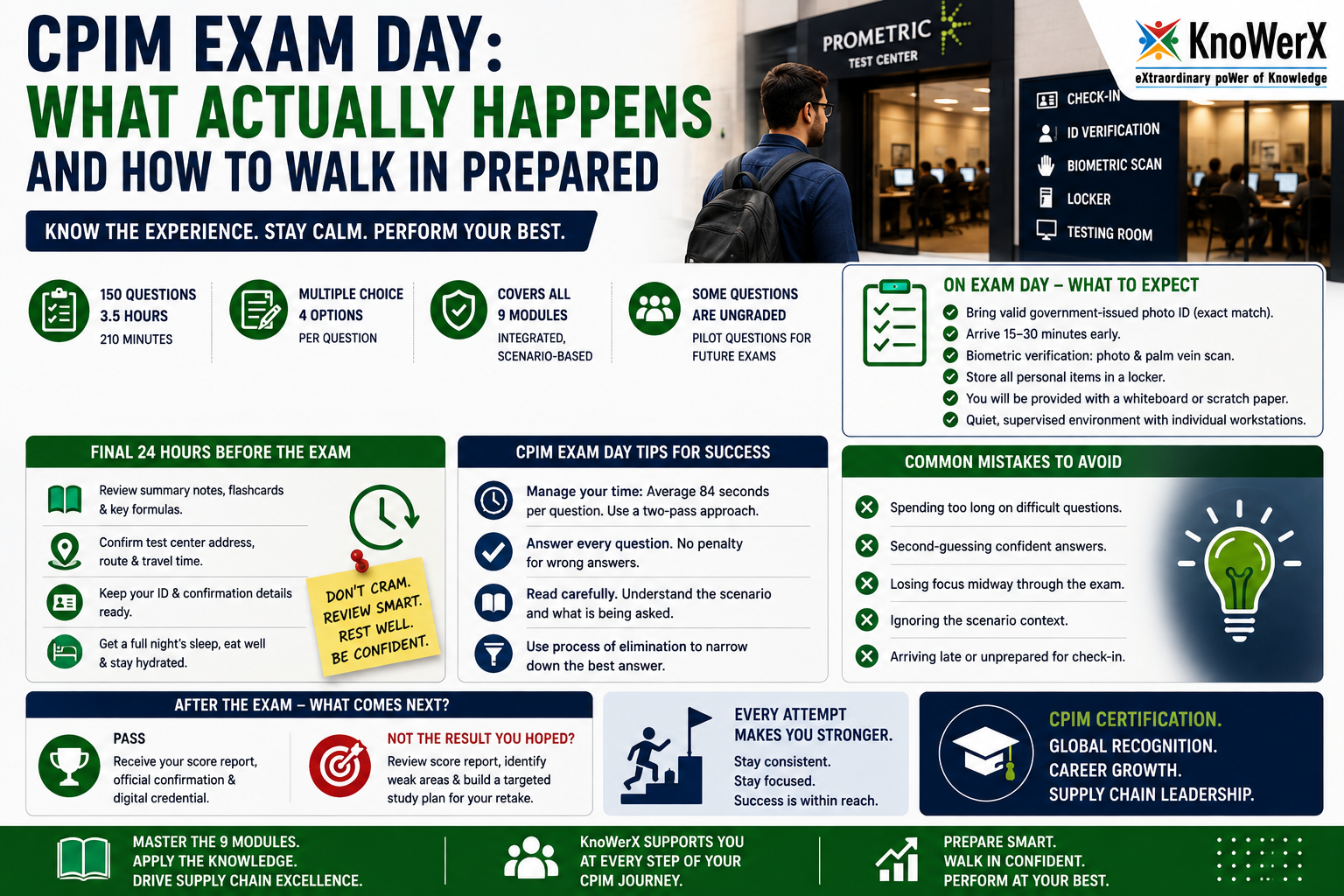
If the result is not what you had expected, you should take a constructive approach. Go through your score report carefully, find the modules you did the worst in and use this to put together a targeted revision plan before booking a retake. Many successful CPIM holders did not pass the first time. The insights provided by the score report make a second attempt much more informed than the first.
At KnoWerX, we support candidates through every stage of the CPIM journey, from the early weeks of module study through to exam day readiness and beyond. Our instructor-led programmes are designed to ensure that when you walk into the test centre, you are prepared not just for the content of the exam but for the full experience of sitting it confidently and performing at your best.
Image Reference: Magnific
Disclaimer: All trademarks, logos, and brand names are the property of their respective owners. All company, product, and service names used in this website are for identification purposes only. Use of these names, trademarks, and brands does not imply endorsement.