
Demand Driven MRP (DDMRP) | Benefits of Supply Chain | KnoWerX
“In today’s business environment supply chains have to respond to changing customer demand, supplier delays, material shortages and production challenges. Traditional planning methods often find it difficult to respond quickly when demand fluctuates often or when long lead times are involved. Thus, companies need planning methods that help to balance the availability of materials, the investment in inventories and the operational efficiency.

Demand Driven MRP (DDMRP)
is an approach to materials planning that uses actual demand signals and strategically positioned inventory buffers to help organisations manage variability across their supply chains.
Unlike planning approaches that rely heavily on forecasts to determine material requirements, DDMRP focuses on protecting the flow of relevant materials through the supply chain while responding to changes in demand and supply conditions.
For supply chain professionals, understanding Demand Driven MRP can provide a useful perspective on how businesses can improve material availability, manage inventory more effectively and respond to disruptions.
In this article, we explain what DDMRP is, how it works, how it differs from traditional Material Requirements Planning (MRP), its potential benefits and how professionals can learn to apply it in supply chain environments.
What Is Demand Driven MRP (DDMRP)?
Demand Driven Material Requirements Planning, commonly known as DDMRP, is a materials planning and execution approach designed to help organisations manage material flows in environments characterised by variability.
Traditional planning systems often calculate material requirements using forecasts, bills of materials, inventory records and production schedules. These calculations can become difficult to manage when customer demand changes, suppliers deliver late or production lead times vary.
DDMRP introduces a demand-driven approach that uses strategically placed inventory buffers to help absorb variability and protect the flow of materials.
These buffers are positioned at selected points in the supply chain based on factors such as lead times, material characteristics and the structure of the supply network. Buffer levels are monitored and adjusted according to relevant planning parameters and changing operating conditions.
It isn’t just about carrying more inventory. Rather, DDMRP focuses on positioning and controlling inventory where it can best protect material flow and operational performance.
For example, a manufacturer may rely on a component with a long replenishment lead time. Should demand suddenly increase, production may be delayed until a shortage arises. A strategically placed buffer can offer protection while the organisation starts replenishment based on signals from demand driven planning.
DDMRP is therefore designed to manage variability, prioritise replenishment and enable a more responsive flow of materials.
How Does Demand Driven MRP (DDMRP) Work?
DDMRP follows a structured approach to planning and replenishing materials. Its implementation involves understanding the supply chain, identifying appropriate buffer locations, determining buffer levels and using demand-related signals to support replenishment decisions.
The main elements include the following.
1. Strategic Inventory Positioning
The first step is to identify where inventory buffers may be required in the supply chain.
Not everything deserves the same protection. Some materials take a long time to be replaced, and others can be obtained immediately. Some components can also have a major impact on production if they become unavailable.
Strategic inventory positioning considers these characteristics to identify points where buffers can help protect the flow of materials.
A company may decide to safeguard a critical component that requires weeks, rather than maintaining the same inventory amount for every item in its warehouse. In strategic inventory positioning, these characteristics help decide where buffers can shield the flow of material. This means a common stocking policy for all materials is avoided.
2. Buffer Profile and Level Determination
Once buffer locations have been identified, appropriate buffer levels must be established.
DDMRP uses buffer profiles and calculations that consider relevant factors such as lead time, average daily usage and variability. The precise parameters depend on the item and the operating environment.
Buffers are typically represented as colour-coded zones, which help planners understand stock positions and replenishment priorities.
These zones are a graphical representation of whether inventory is within its expected range, trending towards a potential shortage or at a level that requires attention.
The buffer settings must be representative of the real operating conditions. If demand patterns, lead times or supply conditions change, the organisation may need to review and adjust these.
3. Dynamic Buffer Adjustments
Supply chains are not often stable for long periods of time. Demand may rise at a seasonal high, a supplier may have a long lead time, or a product may go through a new phase in its lifecycle.
DDMRP incorporates mechanisms for adjusting buffers when relevant conditions change.
The purpose of dynamic adjustments is to ensure that buffer settings remain appropriate as the business environment changes.
DDMRP has mechanisms for reconfiguring buffers when relevant conditions change. me of peak demand than in a lull period.
Poorly sized buffers can create unnecessary inventory or fail to provide sufficient protection, so regular monitoring and appropriate adjustments are important.
4. Demand-Driven Planning
DDMRP uses demand information to help determine replenishment requirements and priorities.
To help determine replenishment requirements and priorities, DDMRP leverages demand information. The focus is on relevant demand signals and the status of inventory buffers.
This approach can help planners identify where replenishment is required and which materials require attention.
Consider a manufacturer who produces a finished product from several components. If the inventory position of one component dips significantly while other materials are available, the planner must understand which replenishment action will best support the production flow.
A demand-driven planning process provides a structure to identify such priorities.
5. Visible and Prioritised Replenishment
The final objective is to support timely replenishment and protect the flow of materials.
Planners need to know what items require action, how urgently they are needed, and where available supply should be sent.
DDMRP takes information about inventory and demand to help decide what to replenish first. This can improve visibility and allow for more targeted planning decisions.
But effective implementation also demands accurate inventory records, coordination with suppliers, execution discipline and the ability to respond to the signals generated by the planning process.

DDMRP vs Traditional MRP: What Is the Difference?
Material Requirements Planning (MRP) is often used to calculate material requirements based on variables such as demand, production schedules, bills of materials, inventory availability and lead times.
DDMRP is based on materials planning principles but has a different approach to handling variability and replenishment priorities.
| Area | Traditional MRP | Demand-Driven MRP |
| Planning emphasis | Calculates material requirements based on demand plans and schedules | Uses demand-driven signals and inventory buffers to manage replenishment |
| Role of forecasts | Forecasts can drive a large proportion of planning calculations. | Forecasts may support planning, while buffer and demand signals help guide replenishment. |
| Inventory approach | Inventory and safety stock policies depend on the planning system and business rules. | Strategically positioned buffers are central to the approach. |
| Variability management | Changes in demand or supply can create frequent planning changes. | Buffers are designed to absorb selected sources of variability. |
| Replenishment priorities | Priorities depend on calculated requirements, schedules and planning parameters. | Buffer status and demand-driven priorities help guide replenishment. |
| Primary objective | Calculate and coordinate material requirements. | Protect material flow while balancing inventory and responsiveness. |
The distinction does not imply that traditional MRP is ineffective or that DDMRP is suitable for every organisation.
In environments where planning data are abundant, variability is manageable, and production processes are well known, traditional MRP works well. If demand changes, lead times are. Organisations should consider DDMRP if they frequently experience material flow disruptions caused by excessive planning nervousness.
Organisations should assess their operational needs, data quality, system capabilities and implementation readiness before selecting an approach.
Benefits of DDMRP for Modern Supply Chains
When implemented appropriately, DDMRP can help organisations address several common challenges in materials planning.
1. Improved Material Availability
Material shortages can interrupt production and delay customer orders. Strategically positioned buffers can help protect critical materials against selected sources of variability.
This can improve the organisation’s ability to maintain material availability, although results depend on buffer settings, supplier performance and execution discipline.
2. Better Inventory Management
Holding too much inventory increases storage costs and ties up working capital. Holding too little can result in shortages and production interruptions.
DDMRP seeks to position inventory where it can protect flow rather than treating all materials identically. This can help organisations evaluate where inventory is necessary and where stock levels may need reviewing.
The goal is not automatically to reduce every inventory balance but to achieve an appropriate balance between availability, risk and cost.
3. Greater Responsiveness to Changing Demand
Demand can change quickly because of seasonal patterns, customer behaviour, market conditions or unexpected orders.
A demand-driven replenishment approach can help planners focus on actual inventory conditions and relevant demand signals. This may support quicker, more informed responses when operating conditions change.
4. Improved Planning Visibility
Supply chain teams often have to manage a high volume of material requirements with competing priorities.
Visible buffer conditions and clear replenishment signals help planners decide what materials to work on right now. This can help to inform more targeted discussions between the planning, procurement, production and supplier management teams.
5. Support for More Reliable Material Flow
Production requires that materials and resources be available in a coordinated manner. One missing key component can throw off a well-orchestrated production schedule.
DDMRP helps organisations to deal with potential interruptions in a more systematic way by focusing on protecting material flow at selected points in the supply chain.
These benefits do not come automatically. Their success depends on the suitability of the approach, the quality of implementation and the consistency of team actions based on planning information.
How Can Professionals Learn DDMRP and Apply It in the Supply Chain?
Understanding DDMRP requires more than learning terminology. Professionals need to understand how the approach relates to existing planning systems, inventory policies and day-to-day operational decisions.
The following steps can help build practical knowledge.
1. Strengthen Your Materials Planning Fundamentals
Begin with the principles of inventory management, demand planning, replenishment, lead times and Material Requirements Planning.
A solid understanding of these topics makes it easier to evaluate what DDMRP changes are and why they may be useful in certain environments.
2. Understand the DDMRP Methodology
Study the key concepts, including strategic inventory positioning, buffer profiles, buffer levels, dynamic adjustments and demand-driven replenishment.
Focus on understanding the purpose of each element and how the different steps work together.
3. Use Practical Supply Chain Examples
Apply the concepts to scenarios involving long supplier lead times, changing demand, component shortages or excess inventory.
For instance, consider how a manufacturer might manage a critical component that has an unpredictable replenishment lead time. Explore where a buffer might be positioned, which factors would influence its size, and how planners could respond when the inventory position changes.
Practical examples can help connect theoretical knowledge with real planning decisions.
4. Review Your Organisation’s Planning Challenges
If you work in supply chain management, look at the challenges that are affecting your current operations.
These may be constant schedule changes, critical material shortages, excess inventory, unreliable supplier lead times or lack of visibility to replenishment priorities.
Grasping these issues can help you decide if DDMRP is worth investigating and what data you would need to evaluate it properly.
5. Explore Structured Learning Opportunities
A structured training programme will give you a more systematic understanding of DDMRP and how to apply it in practice.
Consider the curriculum, instructor qualifications, learning format, hands-on exercises, and any assessment or certification requirements when evaluating the course.
Please check with the training provider before you enrol, especially if you are working towards a specific DDMRP qualification.
Frequently Asked Questions
What is Demand Driven MRP (DDMRP)?
Demand Driven Material Requirements Planning (DDMRP) is a materials planning and execution approach that uses demand signals and strategically positioned inventory buffers to manage variability and protect the flow of materials across the supply chain.
How does Demand Driven MRP work?
DDMRP works by identifying strategic inventory buffer locations, determining appropriate buffer levels, adjusting buffers when operating conditions change, and using demand-related signals to prioritise replenishment. This helps planners respond to changes in demand and supply conditions.
What is the difference between DDMRP and traditional MRP?
Traditional Material Requirements Planning (MRP) calculates material requirements using factors such as demand plans, production schedules, bills of materials and inventory records. DDMRP places greater emphasis on strategically positioned inventory buffers, demand-driven signals and replenishment priorities to help protect material flow.
Ending Note – Is DDMRP Right for Your Supply Chain?
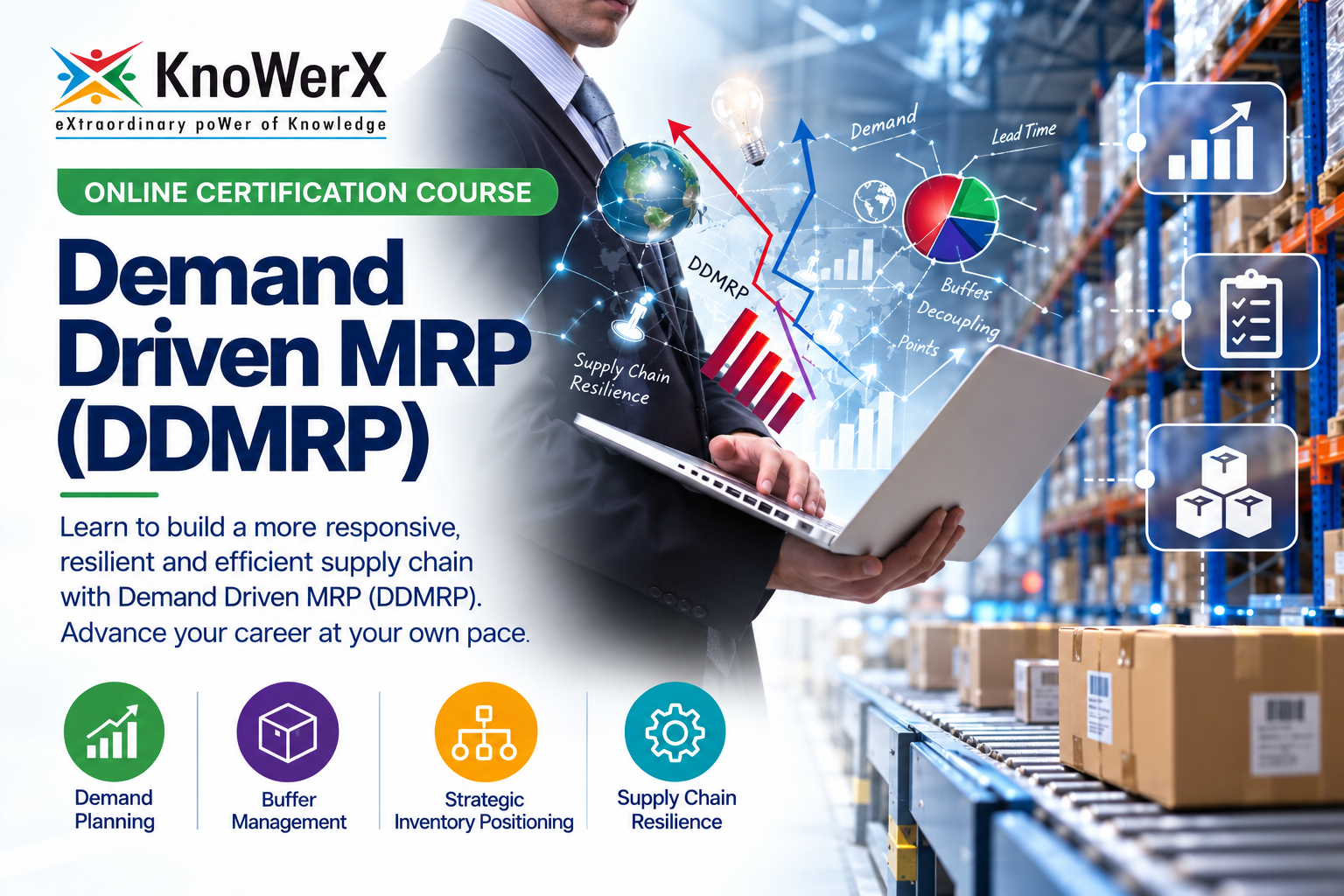
Demand Driven MRP offers an approach to materials planning that emphasises strategic inventory buffers, demand-driven replenishment and the protection of material flow.
For organisations dealing with demand variability, long lead times or recurring material shortages, DDMRP may provide a useful framework for reviewing how inventory is positioned and how replenishment priorities are managed.
However, no planning method is a universal solution. Businesses should evaluate their supply chain characteristics, planning data, operating processes and implementation capabilities before adopting DDMRP.
For supply chain professionals, learning about DDMRP can broaden their understanding of modern materials planning and provide another perspective on inventory and replenishment challenges.
Want to strengthen your supply chain planning knowledge? Explore supply chain learning opportunities with KnoWerX Education and find programmes that align with your professional development goals.
Build your planning knowledge, learn about new approaches and continue to develop the capabilities you need to address modern supply chain challenges.
Image Reference: Magnific
Disclaimer: All trademarks, logos, and brand names are the property of their respective owners. All company, product, and service names used in this website are for identification purposes only. Use of these names, trademarks, and brands does not imply endorsement.