
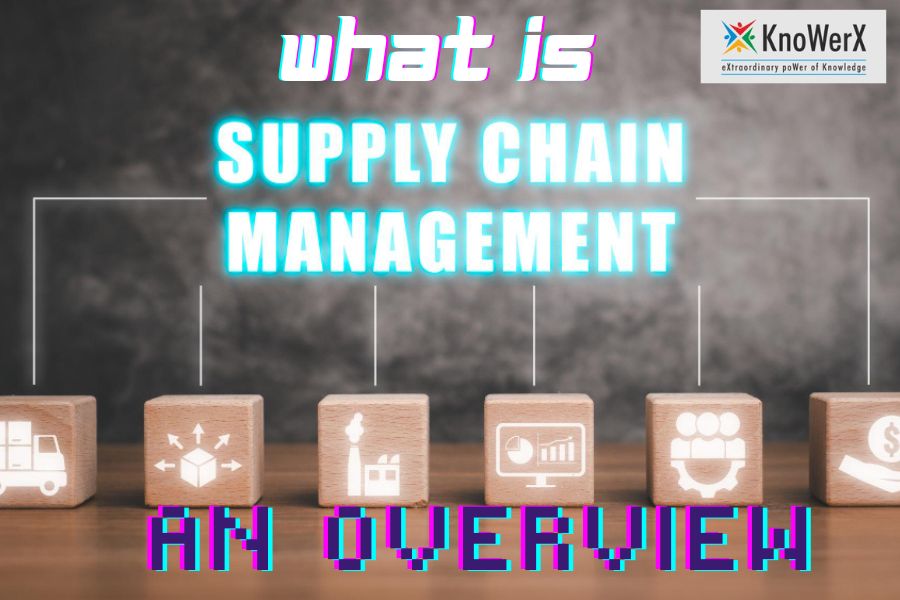
What Is Supply Chain Management (SCM): An Overview
The question what is a scm is often asked in simple terms, yet the answer sits at the centre of how modern businesses survive, scale, and compete. Supply Chain Management is no longer a back-office function concerned only with moving goods from one place to another. It has evolved into a strategic discipline that determines cost structures, customer experience, risk exposure, and long-term resilience.

In an era of global uncertainty, rapid demand shifts, and intense margin pressure, leaders, professionals, and organisations alike must understand what SCM truly means.
Definition of Supply Chain Management (SCM)
To understand what is a scm, it helps to move beyond narrow definitions. Supply Chain Management refers to the coordinated management of the flow of materials, information, finances, and decisions across the entire network that transforms raw inputs into finished products and delivers them to customers.
At its core, SCM integrates suppliers, manufacturers, warehouses, transport providers, distributors, and customers into a single operating system. The objective is not just movement, but optimisation ensuring the right product reaches the right place, at the right time, at the right cost, and with the right level of quality.
Unlike logistics, which focuses primarily on transportation and storage, SCM takes a holistic view. It connects planning with execution, operations with finance, and demand signals with supply responses. When businesses ask what is a scm, the most accurate answer is that it is the discipline that aligns operational activity with business strategy.
Key Components of Supply Chain Management
Understanding what is a scm also requires clarity on its core components and how they function together as an integrated system rather than isolated departments.
The first component is planning and forecasting.
This component defines how demand is anticipated and how supply is structured to meet it. It includes demand forecasting, sales and operations planning, capacity planning, and inventory strategy. Weak planning creates instability across the entire supply chain.
Sourcing and Supplier Management
Sourcing involves selecting suppliers, negotiating contracts, and managing supplier performance. Effective SCM treats suppliers as strategic partners rather than transactional vendors, focusing on reliability, quality, cost, and risk.
Production and Operations Management
This area governs how goods are manufactured or assembled. It includes production scheduling, process optimisation, quality control, and capacity utilisation. Decisions made here directly impact cost, lead time, and service levels.
Warehousing and Inventory Management
Warehousing is not just storage; it is a control point for inventory accuracy, order fulfilment speed, and working capital efficiency. Inventory management balances availability with cost, ensuring neither excess nor shortage dominates the system.
Transportation and Distribution
This component manages the physical movement of goods across the supply chain. It includes route planning, carrier selection, freight optimisation, and last-mile delivery performance.
Technology and Data Visibility
Modern SCM relies on integrated systems that provide real-time visibility across planning and execution. Data enables performance measurement, exception management, and informed decision-making.
Together, these components define the practical reality behind the question what is a scm.
How Supply Chain Management Works (End-to-End Flow)
Supply Chain Management works as an end-to-end flow rather than a sequence of disconnected activities. To truly understand what is a scm, one must see how value moves across the entire lifecycle.
The process begins with suppliers, where raw materials or components are sourced based on demand forecasts and production plans. Information flows upstream in the form of forecasts, schedules, and purchase orders, while materials flow downstream into manufacturing or assembly operations.
In production, raw materials are turned into finished or semi-finished goods. Inventory levels, production rates, and quality outputs are continuously monitored to maintain balance between efficiency and responsiveness.
The finished goods are then moved to warehouses or distribution centres, where they are stored, picked up, packaged, and prepared for delivery. Distribution channels vary depending on business models direct-to-customer, retail distribution, or business-to-business networks.
Parallel to the physical flow is the information flow. Demand signals, order statuses, inventory data, and performance metrics move across systems to enable coordination. Financial flows payments, credits, and working capital move alongside goods and information.
This interconnected movement explains what is a scm: a dynamic system where decisions at one point affect performance across the entire network.
Importance of SCM for Businesses Today
The importance of Supply Chain Management has grown dramatically in recent years. When businesses ask what is a scm, they are often responding to real pressures impacting performance and growth.
Cost Control and Margin Protection
SCM directly influences procurement costs, manufacturing efficiency, logistics expenses, and inventory holding costs. Small improvements in supply chain efficiency often translate into significant financial gains.
Customer Experience and Service Reliability
On-time delivery, product availability, and order accuracy are all outcomes of effective SCM. Inconsistent supply chain performance quickly erodes customer trust.
Risk Management and Resilience
Disruptions whether caused by supplier failures, transportation delays, or demand volatility expose weak supply chains. Strong SCM designs resilience for the network through diversification, visibility, and contingency planning.
Scalability and Growth enablement.
As businesses grow, supply chains must scale without becoming inefficient or fragile. SCM ensures growth does not lead to uncontrolled complexity.
Competitive Advantage
In many industries, supply chain performance is the primary differentiator. Faster response times, lower costs, and greater reliability often matter more than product features alone.
These factors explain why understanding what is a scm is now essential at the leadership level.
Modern Trends Shaping Supply Chain Management
The answer to what is a scm continues to evolve as new trends reshape how supply chains are designed and managed.
Digital Supply Chains and Real-Time Visibility
Companies are investing in integrated platforms that provide end-to-end visibility during planning and execution. Real-time data enables faster, more accurate decisions.
Automation and Advanced Analytics
Automation is improving efficiency in warehouses, production lines, and planning processes. Analytics and artificial intelligence are enhancing forecasting accuracy and scenario modelling.
Resilience-Focused Network Design
Instead of optimising purely for cost, businesses are redesigning their supply networks to balance efficiency with resilience, reducing their dependence on single sources or routes.
Sustainability and Responsible Sourcing
Environmental and social considerations are becoming integral to SCM decisions. Sustainable sourcing, carbon reduction, and ethical compliance are now core performance metrics.
Data-Driven Decision-Making
SCM is shifting from experience-based decisions to data-led insights. Predictive and prescriptive analytics are shaping how organisations respond to change.
These trends redefine what is a scm for the modern enterprise less about control, more about intelligence and adaptability.
Career Opportunities in Supply Chain Management
As SCM grows in strategic importance, career opportunities in this field are expanding rapidly. For professionals asking what is a scm as a career choice, the answer is both broad and future-ready.
Entry-level roles often focus on operations, planning, procurement support, or logistics coordination. As experience grows, professionals move into specialised areas, such as demand planning, sourcing strategies, warehouse management, and transportation optimisation.
Advanced roles include supply chain analytics, process excellence, network design, and transformation leadership. At the senior level, professionals make decisions that affect the company’s strategy, risk management, and growth over the long term.
Success in SCM requires a blend of analytical thinking, cross-functional communication, problem-solving ability, and business understanding. As supply chains become more complex, professionals who understand what is a scm in its full strategic context are increasingly valued.
Frequently Asked Questions
What is Supply Chain Management (SCM)?
Supply Chain Management is the end-to-end coordination of planning, sourcing, production, inventory, transportation, and information flow required to deliver products or services from suppliers to customers efficiently and reliably.
Why is SCM considered a strategic function today?
SCM directly impacts cost structures, service levels, risk exposure, and scalability. In volatile markets, supply chain decisions often determine a company’s ability to compete, grow, and remain resilient.
How is Supply Chain Management different from logistics?
Logistics focuses on execution activities such as transportation, warehousing, and order fulfilment. SCM is broader and strategic, integrating planning, sourcing, production, inventory policy, and performance management across the entire network.
Ending Notes
So, what is a scm? It is the discipline that connects strategy to execution, demand to delivery, and cost to value. Supply Chain Management is no longer an operational afterthought; it is a central driver of business performance, resilience, and competitiveness.
As markets continue to evolve and uncertainty becomes the norm, organisations that invest in strong SCM capabilities position themselves to respond faster, operate smarter, and grow sustainably. Understanding SCM is not just about knowing how supply chains work it is about understanding how modern businesses succeed.
Image Reference: Freepik
Disclaimer: All trademarks, logos, and brand names are the property of their respective owners. All company, product, and service names used in this website are for identification purposes only. Use of these names, trademarks, and brands does not imply endorsement.