Sales and Operations Planning (S&OP) Process | Steps and Benefits
In today’s competitive business environment, organisations need to balance customer demand, production capacity, inventory and financial targets. Businesses may experience stock shortages, excess inventory, production delays and rising operational expenses without proper coordination. The Sales and Operations Planning (S&OP) Process helps organisations to align these activities and make better business decisions.

S&OP assembles multiple functions to create a plan that is consistent with business goals. Combining sales forecasts with operational capabilities allows organisations to improve coordination, optimise the use of resources, and react more effectively to shifts in the market.
What Is the Sales and Operations Planning (S&OP) Process?
Sales and Operations Planning (S&OP) process is a structured business planning process to align demand, supply and financial plans. It encourages teams like Sales, Marketing, Operations, Procurement, Finance and Supply Chain to work towards common goals.
For example, if the sales team is predicting a higher demand for a product, the operations team has to determine if there are enough materials, production capacity and inventory. Finance also needs to understand the possible effect on costs and revenue.
S&OP provides a forum to review this information, resolve conflicts and agree on a realistic business plan. It encourages collaboration and shared responsibility, rather than permitting departments to make decisions independently.
What Are the Key Steps in the S&OP Process?
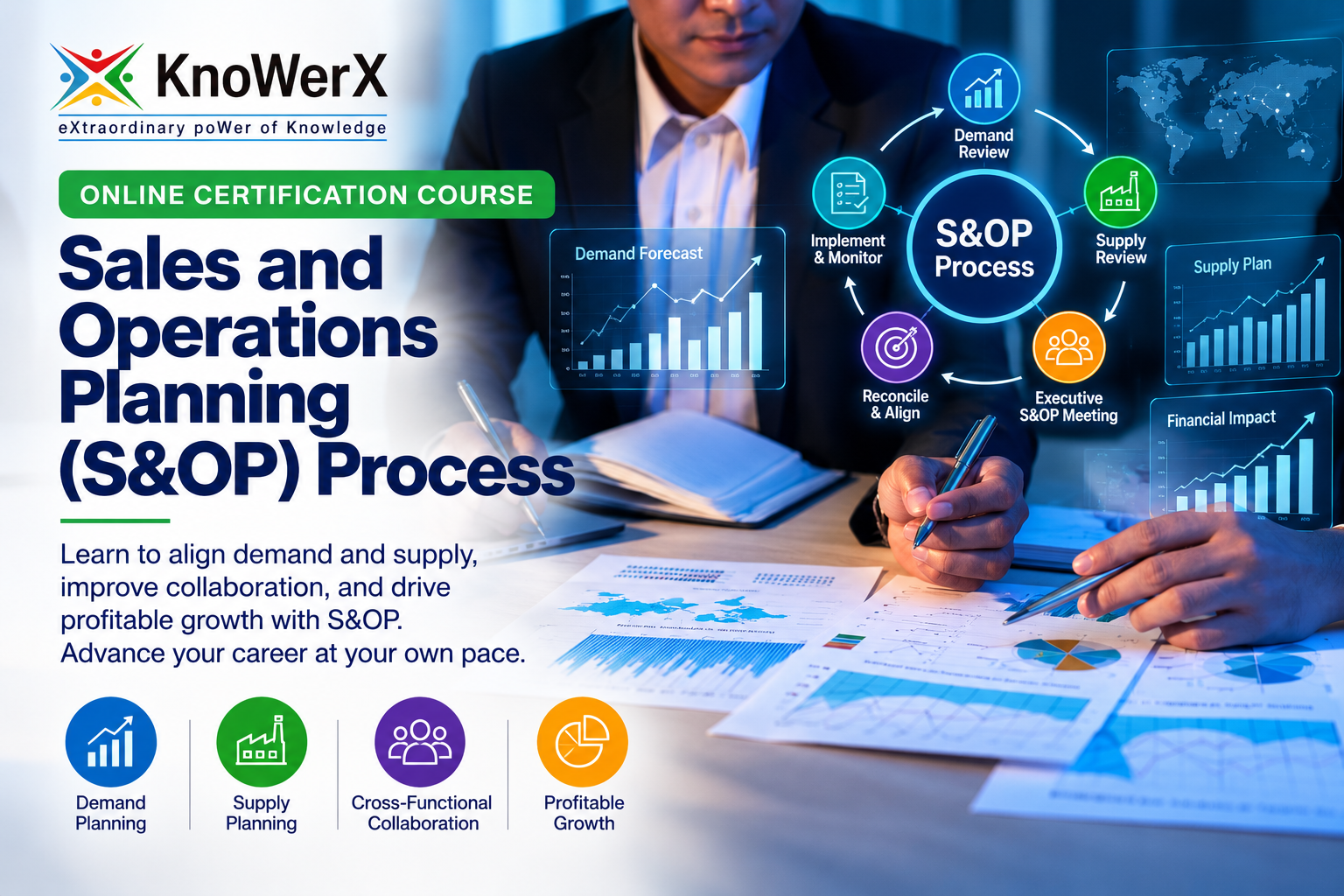
Although the exact approach varies by organisation, a typical S&OP cycle includes the following steps.
- Data Collection: Gather historical sales, present inventory levels, demand projections, production details, and pertinent financial data. Planning is based on correct information.
- Demand planning: Review anticipated customer demand based on forecasts, market information, sales inputs and business assumptions. The aim is to have a realistic picture of future needs.
- Supply planning – Assess the production, procurement, workforce and inventory capabilities to meet the expected demand. Identify capacity challenges and possible supply gaps.
- Reconcile plans: Compare demand and supply plans, identify gaps and evaluate possible solutions. There are options to change production, to change inventory targets or to prioritise certain products.
- Executive review: Bring key decision-makers together to review alternatives, resolve major issues and agree on a plan aligned with business priorities.
- Implementation and monitoring: Communicate the approved plan, assign responsibilities and track performance. Regular reviews help organisations identify deviations and make timely adjustments.
A consistent S&OP cycle enables teams to transition from disconnected forecasts to coordinated decisions.
How Does S&OP Drive Business Growth?
An effective S&OP process can support business growth in several ways.
Improved customer service: Better alignment between demand and supply helps organisations reduce avoidable stockouts and improve product availability.
Better inventory control: Coordinated planning can help businesses avoid unnecessary stock accumulation while maintaining sufficient inventory to meet expected demand.
More efficient resource utilisation: Understanding future demand allows organisations to plan production capacity, workforce requirements and material purchases more effectively.
Improved financial planning: S&OP links operational decisions to business goals, enabling leaders to see the financial impact of various scenarios.
Greater collaboration: When departments work with a shared plan, communication improves and conflicting priorities become easier to address.
These benefits depend on the quality of data, leadership support and the organisation’s ability to execute the agreed plan.
Common S&OP Challenges and How to Overcome Them
S&OP does have its benefits, but it’s not always straightforward to implement.
One common issue is inconsistent or erroneous data. Departments may be working with different forecasts or outdated information. Common definitions, reliable reporting and clear data ownership can improve consistency.
Another issue is the lack of cross-functional collaboration. Teams may focus on their target rather than on the overall business performance. Regular planning meetings, defined responsibilities and management involvement can promote a feeling of shared accountability.
Unrealistic predictions can also be problematic. Organisations should review the accuracy of their forecasts, understand changes in demand and update their assumptions when market conditions change.
Finally, some companies use S&OP as a reporting exercise instead of a decision-making process. To avoid such pitfalls, meetings should focus on exceptions, trade-offs, risks and action plans – not just numbers.
How Can Professionals Master the S&OP Process?
S&OP principles are relevant to professionals in supply chain management, demand planning, production, procurement, sales or finance.
Understand the link between demand forecasting, supply planning, inventory management and financial objectives. Getting comfortable with planning data and improving analytical skills also improves decision-making.
Hands-on experience is just as important. Professionals will learn how S&OP works in real business situations by attending cross functional meetings, analysing demand-supply gaps and evaluating alternative scenarios.
Structured supply chain training can be a basis for developing these capabilities. When selecting a programme, consider the curriculum, the mode of learning and its relevance to your career goals. KnoWerX is a starting point for exploring supply chain education and professional development opportunities.
Frequently Asked Questions
What is the Sales and Operations Planning (S&OP) process?
The Sales and Operations Planning (S&OP) process is a structured business planning approach that aligns demand forecasts, supply capabilities, inventory levels and financial objectives to support better decision-making.
What are the key steps in the S&OP process?
The key steps in the S&OP process are data collection, demand planning, supply planning, reconciliation of demand and supply plans, executive review, and implementation and monitoring.
Why is the S&OP process important for businesses?
S&OP is important because it improves coordination between departments, enhances inventory management, reduces supply-demand mismatches, optimises resource utilisation and supports business growth.
Ending Notes
The Sales and Operations Planning (S&OP) Process enables organisations to coordinate planning to align customer demand, operational capacity and financial objectives. S&OP can drive smarter business decisions and long-term success through better collaboration, improved inventory decisions and identification of supply-demand gaps.
Developing S&OP knowledge is a meaningful way for professionals to enhance their supply chain planning skills and improve organisational performance.
Image Reference: Magnific
Disclaimer: All trademarks, logos, and brand names are the property of their respective owners. All company, product, and service names used in this website are for identification purposes only. Use of these names, trademarks, and brands does not imply endorsement.