7 Inventory Control Methods | Optimise Stock Management | KnoWerX
Inventory is one of the largest investments for most businesses. Whatever your organisation does – manufacturing, retail, distribution or e-commerce – having the right stock levels is essential if you are to satisfy customer demand and keep operations running smoothly. Too much inventory leads to higher storage and carrying costs, while too little can lead to stockouts, production delays and missed sales opportunities.

This is why companies need to have effective methods of inventory control. Inventory control allows organisations to monitor stock, manage replenishment and maintain the availability of materials and products without unnecessary accumulation.
Understanding different inventory control methods is an important skill for supply chain professionals. When done right, it can lead to increased stock accuracy, reduced costs and better business performance.
What Are Inventory Control Methods and Why Are They Important?
Inventory control methods are the techniques and processes businesses use to monitor, manage, and control the movement and storage of inventory. They assist organisations in finding out the stock they have, where it is located, the quantity needed and the time for refilling.
Inventory control covers the raw materials, work-in-progress items, finished goods and other materials required for business operations.
Effective inventory control is important because it helps businesses:
- Maintain sufficient stock to meet customer requirements.
- Avoid excess and obsolete inventory.
- Reduce inventory holding and storage costs.
- Improve stock accuracy and visibility.
- Support uninterrupted production and operations.
- Make better purchasing and replenishment decisions.
- Improve customer service and order fulfilment.
There is no single inventory control method suitable for every organisation. Businesses should select techniques based on their products, demand patterns, supply chain structure and operational requirements.
7 Effective Inventory Control Methods Every Business Should Know
1. ABC Analysis
ABC analysis is an inventory classification method that divides inventory items into three categories based on their value or contribution to overall inventory investment.
- A items: High-value items that generally represent a smaller proportion of total inventory items but a significant share of inventory value.
- B items: Medium-value items that require moderate monitoring and control.
- C items: Low-value items that generally represent a larger proportion of inventory items but a smaller share of total inventory value.
ABC analysis helps businesses focus their efforts on inventory management. Items rated A are of high value and may require tighter controls and frequent monitoring. Items rated C may be managed with simpler procedures.
For example, a manufacturing company may closely monitor expensive electronic components and apply less intensive controls to low-cost consumables.
2. Just-in-Time (JIT) Inventory Management
Just-in-time inventory management emphasises that materials and products should be delivered just before they are needed in production or for customer use.
The objective is to limit unnecessary stock and to reduce the costs of keeping surplus stock.
JIT can help businesses:
- Reduce inventory holding costs.
- Minimise excess stock.
- Improve material flow.
- Reduce warehouse space requirements.
However, JIT depends heavily on reliable suppliers, accurate planning and consistent replenishment. Unexpected supplier delays or transportation disruptions can affect operations if sufficient contingency arrangements are not available.
3. Economic Order Quantity (EOQ)
The Economic Order Quantity (EOQ) is a method for determining an optimal order quantity based on a trade-off between ordering costs and inventory holding costs.
If you order too often, your costs for purchasing and administration can increase. Ordering too much at once will increase your storage and inventory carrying costs.
The EOQ model makes certain assumptions that allow businesses to find an order quantity that minimises total costs.
The commonly used formula is:
EOQ=2DSH
Where:
- D = Annual demand
- S = Ordering cost per order
- H = Annual holding cost per unit
EOQ can support purchasing and replenishment decisions, although actual requirements may vary due to demand fluctuations, supplier constraints and quantity discounts.
4. FIFO and LIFO Inventory Methods
FIFO and LIFO are inventory methods that describe how inventory items are assumed to flow through inventory.
FIFO (First In, First Out) assumes that the oldest stock is sold or issued first. It is especially helpful when it comes to products with expiration dates, or products that may deteriorate over time, such as food, pharmaceuticals, and certain raw materials.
LIFO (last in, first out) assumes that the last inventory purchased is the first one issued or sold. Its use is dependent on the accounting requirements of the organisation and the accounting standards that exist.
FIFO is often used in physical stock management to reduce the risk of having inventory that is expired, damaged or obsolete.
5. Reorder Point (ROP) Method
The reorder point method helps businesses determine when to place a new order to replenish inventory.
A reorder point is generally calculated using demand during lead time and, where appropriate, safety stock.
ROP=(Average DemandLead Time)+Safety Stock
For example, if a business uses 20 units per day, has a supplier lead time of five days, and maintains safety stock of 30 units, the reorder point would be:
ROP=(205)+30=130 units
This means replenishment should be initiated when inventory reaches approximately 130 units, subject to the organisation’s planning assumptions.
The reorder point method helps reduce stockout risks and supports more systematic replenishment.
6. Cycle Counting
Cycle counting is a method of checking inventory accuracy by physically counting selected items regularly rather than conducting only one full physical inventory count at a particular time.
Businesses can schedule counts based on item value, importance, movement frequency or inventory risk.
For example, high-value or fast-moving items may be counted more frequently than low-value items with limited movement.
Cycle counting helps organisations:
- Identify stock discrepancies.
- Improve inventory record accuracy.
- Detect process or transaction errors.
- Reduce dependence on annual stock counts.
- Improve confidence in inventory information.
Consistent cycle counting can support better inventory visibility and operational control.
7. Safety Stock Management
Safety Stock is extra inventory held to protect against uncertainty in demand or supply.
Businesses may face unexpected increases in demand from customers, delays in suppliers, transportation issues or changes in lead times for replenishment. This uncertainty is where safety stock comes in as a buffer.
The amount of safety stock you need depends on the variability of demand, the reliability of the supplier, the lead time and the desired level of customer service.
Keeping too little safety stock increases the risk of stockouts, while keeping too much increases inventory costs. So firms should review safety stock levels regularly.

How Effective Inventory Control Methods Improve Business Performance
Using suitable inventory control methods can improve business performance in several ways.
Cost reduction: Better stock planning can reduce unnecessary inventory investment, storage expenses and carrying costs.
Better product availability: Good replenishment methods help companies keep inventory to meet customer and manufacturing needs.
Increased stock accuracy: By using techniques such as cycle counting, you can detect inaccuracies and improve the dependability of your stock records.
Better working capital management – Reducing excess inventory frees up cash for other business operations.
Better operational efficiency: Clear policies and procedures for inventory help teams better manage purchasing, storage and stock movement.
Enhanced customer satisfaction – Ensuring product availability and reducing fulfilment delays can help to ensure a more reliable customer experience.
Benefits will be related to the extent to which inventory processes are consistently applied and monitored.
Common Inventory Control Challenges and Best Practices to Overcome Them
Even businesses with established inventory processes can face challenges.
Inaccurate inventory records: Differences between physical stock and system records can be Wrong inventory records: Discrepancies between the physical stock and the records in the system can create bad purchasing decisions. Regular cycle counts and timely transaction updates improve accuracy.
Unpredictable demand: Variations in demand from customers can result in excess inventory or inventory shortages. Businesses should regularly review demand information and update planning assumptions.
Supplier delays: Lead times are not reliable and can affect production and replenishment. Keeping tabs on suppliers and evaluating contingency options can help to reduce the risk of dependency.
Poor inventory visibility: Lack of accurate information about stock locations and quantities Even companies with a solid inventory process can have a tough time.ised processes can improve visibility.
Excess and obsolete inventory: Products that move slowly or become outdated can tie up working capital. Regular inventory reviews and appropriate classification techniques can help identify such items.
How Can Supply Chain Professionals Develop Inventory Management Expertise?
Effective inventory management requires more than knowing how to count and store stock. Professionals need to understand demand, replenishment, inventory planning, supplier lead times and the relationship between inventory and business performance.
A structured inventory management course can help learners develop knowledge of these concepts and understand how different inventory control methods are applied in business operations.
KnoWerX has been involved in supply chain education and professional training since 1992. Its programme portfolio includes learning opportunities in inventory management, planning, procurement, warehousing and broader supply chain management.
Professionals interested in developing specialised inventory knowledge can explore relevant KnoWerX programmes, including its Certified Inventory Management Officer (CIMO) and other supply chain learning opportunities.
Frequently Asked Questions
What are inventory control methods?
Inventory control methods are techniques businesses use to monitor, organise and manage stock to maintain the right inventory levels and minimise costs.
What are the most effective inventory control methods?
Common methods include ABC analysis, Just-in-Time (JIT), Economic Order Quantity (EOQ), FIFO, LIFO, reorder point planning, cycle counting and safety stock management.
How can businesses improve inventory control?
Businesses can improve inventory control through accurate demand forecasting, regular stock audits, inventory tracking systems and appropriate replenishment policies.
Strengthen Your Inventory Management Skills with KnoWerX
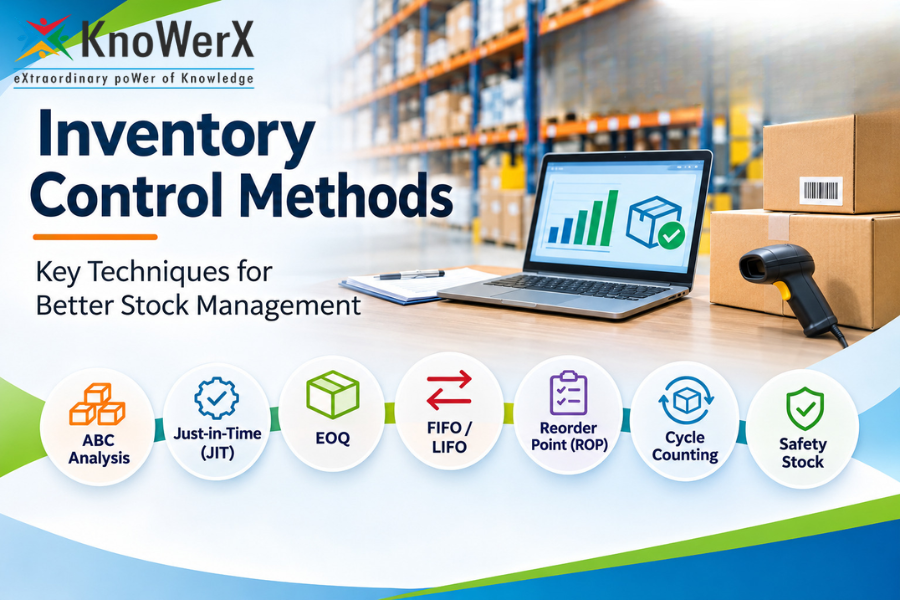
Inventory control is important for businesses who want to maintain stock availability, reduce unnecessary costs and improve supply chain performance. To manage inventory effectively there are different ways like ABC analysis, JIT, EOQ, FIFO, reorder point planning, cycle counting and safety stock management.
Understanding these techniques can improve the ability of professionals to aid inventory planning and operational enhancement.”
Explore inventory management and supply chain training programmes from KnoWerX to develop relevant knowledge and take your career to the next level.
Contact KnoWerX to learn more about our available inventory management training programmes and upcoming schedules.
Image Reference: Magnific
Disclaimer: All trademarks, logos, and brand names are the property of their respective owners. All company, product, and service names used in this website are for identification purposes only. Use of these names, trademarks, and brands does not imply endorsement.