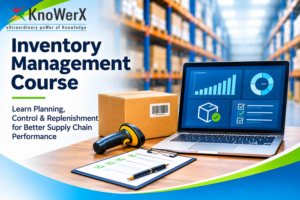
Inventory Management Course | Build Practical Inventory Skills | KnoWerX
Inventory management is critical to the success of supply chain operations. Manufacturing, retail, e-commerce, pharmaceuticals and distribution businesses require effective inventory management to control costs, ensure product availability and meet customer expectations.
Inefficient stock control leads to overstocking, lack of materials, higher warehousing costs and interruptions in the company’s activities. In contrast, good inventory practices help organisations keep the right level of inventory and use working capital in the best way.
As companies focus on improving operational efficiency, professionals with knowledge of inventory management are becoming increasingly valuable. A good Inventory Management Course will teach you about stock control, replenishment and other vital supply chain concepts such as inventory planning.
If you are starting your career or looking to upgrade your current skills, selecting the right inventory management course can be a crucial step in your professional growth.

Understanding Inventory Management and Its Importance in Business
Inventory management refers to the process of planning, storing, monitoring and controlling Inventory management is the process of planning, storing, tracking and controlling the materials and products a business needs. ss, finished goods and spare parts. Organisations need to carefully manage these items to ensure that the required stock is available when needed.
Good inventory management is essential for achieving the right balance between product availability and investment in inventory.
Some important objectives include:
- Maintaining sufficient stock to meet customer demand.
- Avoiding unnecessary inventory accumulation.
- Reducing storage and inventory carrying costs.
- Preventing stockouts and production interruptions.
- Improving inventory accuracy and visibility.
- Supporting efficient purchasing and replenishment decisions.
For example, a manufacturing company requires raw materials to keep its production schedule. Materials not available can delay production. But buying too much can increase storage costs and tie up working capital.
Similarly, retailers need to have enough finished goods to fulfil customer orders without accumulating products that may become obsolete or difficult to sell.
That’s why inventory management is more than simply maintaining stock records. It’s about making informed decisions that affect business performance and supply chain efficiency.
Essential Topics Covered in a Good Inventory Management Course
A comprehensive inventory management course should help participants understand the principles, methods and practices used to manage inventory effectively.
The exact syllabus depends on the training programme, but some important topics to consider are:
- Inventory Management Fundamentals
Understanding the different types of inventory and their role in business operations is the starting point. Learners should understand raw materials, work-in-progress, finished goods and maintenance-related inventory.
- Inventory Planning
Inventory planning helps businesses determine how much stock they need and when it should be available. It involves understanding demand, supply requirements and replenishment lead times.
- Inventory Control Techniques
Inventory control methods help organisations monitor stock and prioritise their management activities. Techniques such as ABC analysis can help businesses classify inventory according to its value and importance.
- Demand Forecasting
Demand forecasting supports inventory planning by helping organisations to estimate future product requirements. Understanding demand patterns can help reduce the risk of both excess inventory and stock shortages.
- Replenishment Management
Replenishment involves deciding when and how much inventory should be ordered. Understanding reorder points, lead times and safety stock can help professionals make better replenishment decisions.
- Inventory Performance Measurement
Businesses use inventory-related performance indicators to evaluate how effectively they manage stock. Understanding inventory accuracy, stock availability and inventory turnover can help professionals identify improvement opportunities.
- Warehouse and Materials Management
Inventory management closely connects with warehousing and materials handling. Understanding storage, stock movement and warehouse processes can support better inventory control.
Developing knowledge across these areas can help professionals understand how inventory decisions affect procurement, production, warehousing and customer service.

How to Choose the Best Inventory Management Course
With different training programmes available, it is important to carefully consider which inventory management course is right for you.
Here are some important factors to evaluate before enrolling.
Understand your learning objectives
Start by identifying what you want to achieve. Are you looking to develop basic inventory management knowledge, improve your current job performance or prepare for a specialised supply chain role?
Your objectives will help you determine which type of programme is most suitable.
Review the course syllabus
Check whether the programme covers relevant topics such as inventory planning, stock control, replenishment, demand management and inventory performance measurement.
A structured syllabus can help ensure that you develop knowledge across the important areas of inventory management.
Consider professional recognition
Some learners may prefer a specialised professional programme or certification that supports their career development. Explore the programme’s purpose, learning outcomes and recognition before making a decision.
Evaluate the training provider
Look for a training provider with experience in supply chain and inventory management education. Consider its programme portfolio, training approach and available learning support.
Choose a suitable learning format
Working professionals may prefer virtual instructor-led training because it allows them to participate from different locations. Others may prefer classroom learning.
KnoWerX offers different training formats, including classroom instructor-led and virtual instructor-led programmes, depending on course availability.
Consider practical relevance
Inventory management concepts must connect with actual business requirements. Look for learning that helps you understand how inventory decisions influence costs, material availability and operational performance.
Taking these factors into account can help you choose a course that aligns with your professional requirements.
Career Opportunities and Benefits of Learning Inventory Management
Inventory management knowledge is useful across several industries, as almost every organisation that handles materials or products requires effective stock control.
Completing a relevant course can help professionals develop capabilities that support different career paths.
Some possible roles include:
- Inventory Executive: Responsible for monitoring stock levels, maintaining inventory records and supporting stock control activities.
- Inventory Analyst: Analyses inventory information and identifies opportunities to improve stock performance.
- Materials Planner: Coordinates material requirements to support production and operational schedules.
- Warehouse Manager: Oversees warehouse activities, storage processes and inventory accuracy.
- Supply Chain Planner: Coordinates demand, supply and inventory planning activities.
- Operations Manager: Uses inventory information to support efficient business operations.
Learning inventory management can also provide several professional advantages.
Better decision-making: Understanding inventory concepts can help professionals make better choices about stock and replenishment.
Better operational understanding: Learners gain a broader view of how inventory ties in with procurement, production, warehousing and distribution.
Enhanced professional skills: Specialised knowledge can enable professionals to take on additional responsibilities in inventory and supply chain operations.
Career development: Knowledge of inventory management can be a valuable asset for professionals looking to advance their careers in supply chain and operations.
The training programme does not guarantee a job or promotion. But the knowledge you create can strengthen your professional profile and get you ready for bigger responsibilities.
Why Choose KnoWerX Education for Inventory Management Training?
Selecting the right training provider is an important step in your professional development journey.
Since 1992, KnoWerX Education has provided supply chain education and professional training. It has a range of training programmes in the fields of supply chain management, planning, procurement, inventory, warehousing and other related business disciplines.
For those interested in inventory management, KnoWerX offers special learning opportunities, such as its Certified Inventory Management Officer (CIMO) Professional Graduate Programme.
Its broader programme portfolio includes ASCM certifications, ASCM certificate programmes, other KnoWerX Professional Graduate Programmes and specialised supply chain management training.
Some relevant learning options include:
- CIMO – Certified Inventory Management Officer: A specialised KnoWerX programme focused on inventory management.
- ASCM CPIM – Certified in Planning and Inventory Management: An ASCM certification that focuses on planning and inventory management.
- CWMP – Certified Warehouse Management Professional: A KnoWerX programme focused on warehouse management.
- ASCM Procurement Certificate: A focused learning programme for professionals interested in procurement.
These programmes cover different aspects of supply chain management. The right choice depends on your current experience, learning objectives and career plans.
KnoWerX offers classroom and virtual instructor-led training options, as well as other learning formats depending on programme availability.
By exploring its programmes, you can identify a learning opportunity that meets your professional development requirements.
Frequently Asked Questions
What topics should an inventory management course cover?
Important topics include inventory planning, demand forecasting, stock control, replenishment, safety stock, inventory analysis and performance measurement.
Who should enrol in an inventory management course?
Supply chain professionals, warehouse managers, procurement executives, inventory planners, operations managers and individuals interested in these careers can benefit.
How do I choose the right inventory management course?
Consider the course curriculum, practical relevance, certification or programme recognition, training format and alignment with your career goals.
Take the Next Step Towards Better Inventory Management Skills
Inventory management is important to control costs, maintain product availability and improve supply chain performance. Proper knowledge development helps professionals to develop deeper understanding of inventory planning, stock control and replenishment processes.
When choosing an inventory management course, think about the syllabus, the training provider, the learning format, and the relevance to your career goals.
If you want to strengthen your inventory management knowledge, explore the Certified Inventory Management Officer (CIMO) programme and other relevant supply chain training opportunities that KnoWerX offers.
Contact KnoWerX Education to learn more about available inventory management programmes, training schedules and enrolment options.
Image Reference: Magnific
Disclaimer: All trademarks, logos, and brand names are the property of their respective owners. All company, product, and service names used in this website are for identification purposes only. Use of these names, trademarks, and brands does not imply endorsement.