ASCM Resilience Certificate | Benefits, Skills and Training | KnoWerX
Today’s supply chains are more uncertain, as changing customer demand, supplier disruptions, transportation challenges and global market shifts all have an impact. For a business to succeed, it must be more than just operationally effective; it must be able to react to unforeseen events and bounce back quickly. This makes supply chain resilience a key focus for organisations across all industries .
The ASCM Resilience Certificate is for professionals who are interested in learning about supply chain resilience and want to grow their understanding of handling disruption. These capabilities can enable professionals to contribute to risk-aware planning, business continuity, and more flexible supply chain operations.
What Is the ASCM Resilience Certificate?
The ASCM Resilience Certificate is a professional learning credential aligned with the Association for Supply Chain Management (ASCM). It focuses on supply chain resilience, giving learners the opportunity to investigate why supply chains are vulnerable to disruption and how organisations can prepare for uncertainty.
Resilience is not just a reaction to something going wrong. It means identifying potential vulnerabilities, developing response plans, evaluating alternatives and restoring operations when disruptions occur.
For example, if a manufacturer relies on only one supplier and that supplier cannot deliver materials, the manufacturer may delay production. A solid understanding of resilience can help supply chain professionals identify such vulnerabilities and consider options like alternative suppliers, better visibility and contingency planning.
What Will You Learn in the ASCM Resilience Certificate?
Current ASCM programme information should be checked for the exact curriculum. Generally speaking, supply chain resilience learning can help professionals to understand several important areas:
- Supply chain risks: Understand how disruptions in suppliers, logistics, operations and markets can impact business performance.
- Risk assessment: Know the significance of identifying weaknesses and assessing the possible effect.
- Contingency planning: Examine how alternative plans and response procedures can help organisations be ready for unexpected events.
- Supply Chain Visibility: See how timely information on suppliers, inventory and logistics leads to better decisions.
- Business continuity: Learn why organisations need plans to maintain or restore critical operations during disruptions.
- Resilience strategies: Examine how supplier diversification, collaboration and flexible planning can improve preparedness.
These concepts provide a basis for understanding how organisations can balance operational efficiency with their ability to respond to change.
Why Is Supply Chain Resilience Important for Businesses?
Supply chain disruptions may impact production schedules, product availability, customer service and operating expenses. Unprepared organisations may find it hard to react quickly, particularly if many parts of the supply chain are affected at the same time.
Building resilience can help business performance in several ways.
Better risk preparedness: Identifying potential vulnerabilities in advance gives teams more time to evaluate response options.
Improved continuity: Contingency plans help organisations maintain essential activities and restore operations more efficiently after a disruption.
Stronger supplier management: Understanding supplier dependencies encourages businesses to assess sourcing risks and consider appropriate alternatives.
More informed decisions: Better visibility and risk awareness help managers evaluate trade-offs between cost, service and reliability.
Greater adaptability: Resilient supply chains can adjust plans when demand, supply conditions or transportation arrangements change.
Resilience does not mean eliminating every risk. Instead, it means preparing to manage uncertainty and limiting the impact of disruptions where possible.
Who Should Pursue the ASCM Resilience Certificate?
The certificate might be worth exploring for professionals involved in supply chain planning, procurement, logistics, operations, supplier management, or risk assessment.
Supply chain managers can apply concepts of resilience to enhance their approach to planning for disruption. Procurement teams may want to consider supplier dependencies, and logistics and operations teams can apply resilience thinking to continuity and recovery planning.
The programme may also appeal to professionals who want to broaden their knowledge of the supply chain or who want to understand the link between risk management and operational performance.
Before enrolling, review ASCM’s current eligibility requirements, curriculum, assessment format and credential details to confirm that the programme suits your experience and learning objectives.
Why Choose KnoWerX for ASCM Resilience Certificate Training?
KnoWerX is dedicated to supply chain education and professional development. If you’re a professional interested in the ASCM Resilience Certificate, review the training options available from KnoWerX, and ask about the assistance available for this credential.
When assessing a training provider, consider the relevance of the learning content, format of delivery, the trainer’s expertise and the support provided throughout the learning process. Furthermore, ensure the offering has the specific ASCM certificate you intend to pursue.
You can review these details before enrolling to help you select a learning option that matches your professional goals.
Frequently Asked Questions
What is the ASCM Resilience Certificate?
The ASCM Resilience Certificate is a professional learning credential focused on supply chain resilience. It helps professionals understand supply chain risks, disruption preparedness, contingency planning and strategies for building more adaptable supply chains.
What topics are covered in the ASCM Resilience Certificate?
Supply chain resilience learning generally covers risk identification, vulnerability assessment, contingency planning, supply chain visibility, business continuity and resilience strategies. Refer to the latest ASCM programme details for the exact curriculum.
Why is the ASCM Resilience Certificate important for supply chain professionals?
The certificate can help professionals develop a better understanding of how to anticipate supply chain disruptions, evaluate risks and contribute to business continuity and more resilient operations.
Ending Notes – Prepare for a More Resilient Supply Chain Future
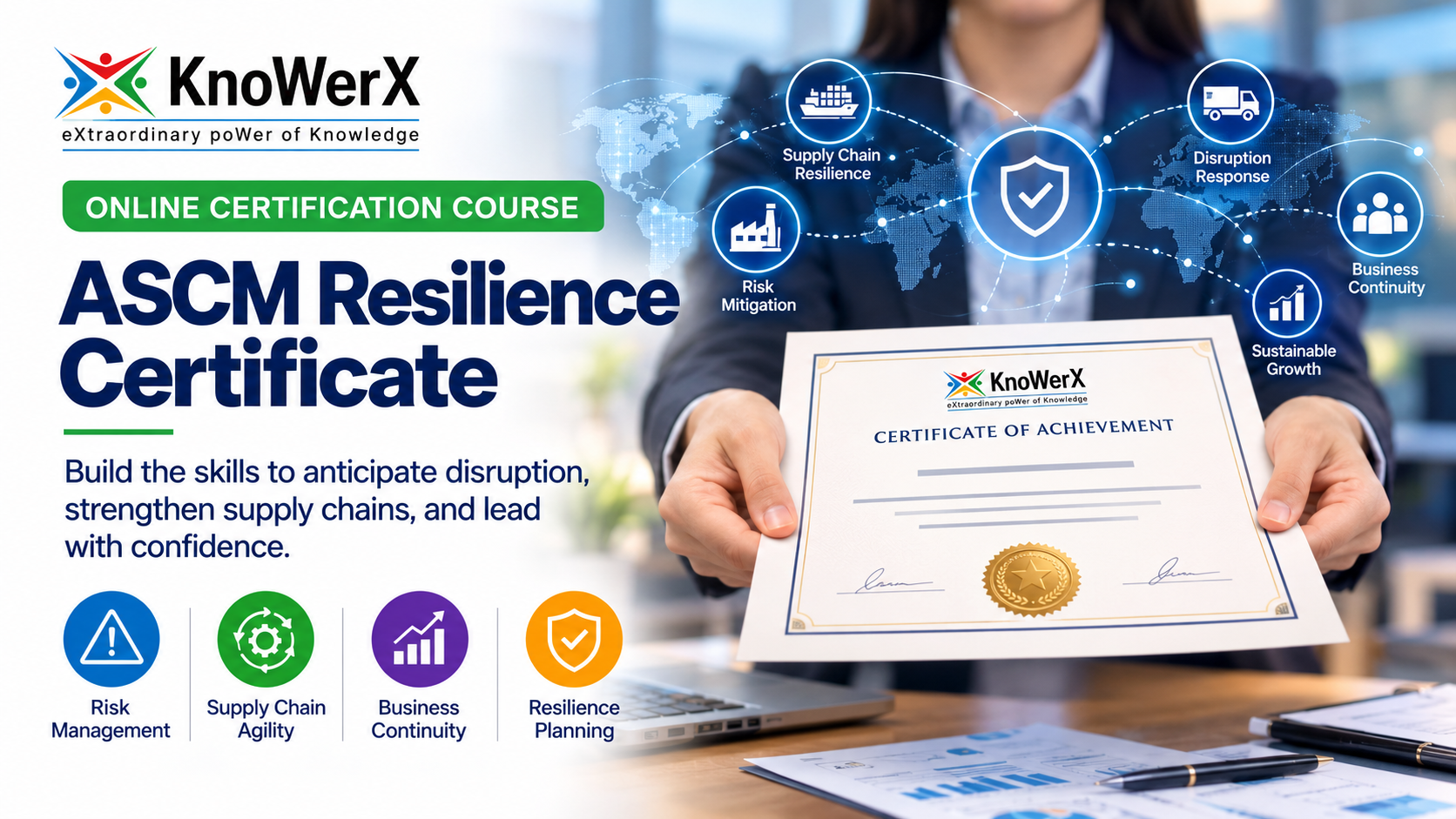
Supply chain resilience is becoming an increasingly important capability for organisations operating in uncertain business environments. Understanding risks, contingency planning, and improving supply chain visibility are ways in which experts can help contribute to stronger and more adaptable operations.
For example, you can consider the ASCM Resilience Certificate as a way to grow your knowledge in this area. Review the programme details below, identify your learning goals and choose the right training path to strengthen your supply chain capabilities.
Image Reference: Magnific
Disclaimer: All trademarks, logos, and brand names are the property of their respective owners. All company, product, and service names used in this website are for identification purposes only. Use of these names, trademarks, and brands does not imply endorsement.