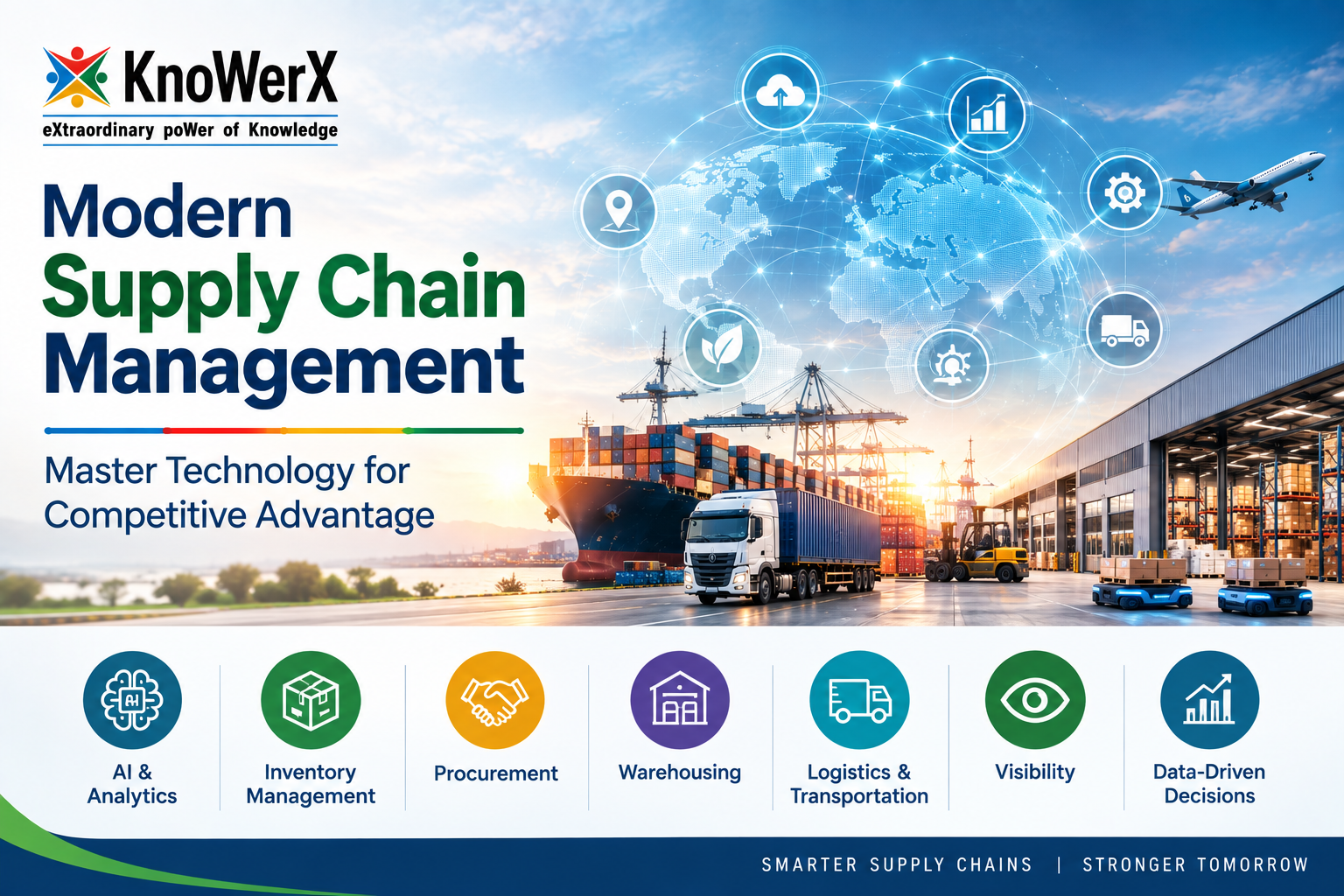
Modern Supply Chain Management | Master Technology for Competitive Advantage | KnoWerX
Supply chain management has been transformed in a profound way over the last decade. What was once a function driven by spreadsheets, phone calls and reactive decision-making is now a data-driven, technology-enabled discipline that can anticipate disruptions, optimise operations in real time and deliver competitive advantage at scale. By 2026, it will not be a question of whether technology should be included in modern supply chain management, but how quickly professionals and organisations can develop the capability to effectively leverage it.
Demand Forecasting
“Artificial intelligence and machine learning have transformed the way that organisations approach demand forecasting in modern supply chain management. AI-driven tools that can handle much larger and more diverse data sets including social media signals, weather patterns, economic indicators and real-time point-of-sale data are increasingly complementing traditional statistical models that remain useful, to generate forecasts that are more accurate and more responsive to market changes. AI is specifically mentioned as one of the most important technologies that is changing the way organisations forecast and respond to demand variability in ASCM’s 2026 supply chain trends.
Inventory Management
IoT-enabled sensors and real-time tracking platforms are transforming inventory management by giving organisations continuous, accurate visibility into stock levels, locations, and conditions across their entire network. This real-time data eliminates the guesswork that historically led to both stockouts and excess inventory, enabling more precise replenishment decisions and significantly reducing carrying costs. Automated replenishment systems, triggered by live inventory data rather than periodic reviews, are becoming standard practice in modern supply chain management environments.
Procurement
Digital procurement platforms and AI-driven supplier intelligence tools are changing the way organisations find, assess, and handle suppliers. Today, procurement teams in supply chain management can use real-time data on supplier risks, automated systems for managing contracts, and tools for analysing spending to find ways to reduce costs throughout their supply base. Blockchain technology is becoming more important in procurement. It offers a permanent record of supplier transactions and certifications, which improves transparency and lowers the chances of fraud and non-compliance.
Warehousing
Robotics and automation have arguably had their most visible impact in warehousing. Autonomous mobile robots, automated storage and retrieval systems, and AI-powered warehouse management platforms are enabling organisations to process higher order volumes with greater accuracy and lower labour dependency. ASCM’s 2026 trends highlight robotics as a defining technology for smarter, more responsive supply chains, particularly as organisations seek to build warehouse operations that can scale rapidly in response to demand fluctuations.
Logistics and Transportation
Digital twins, which are virtual copies of real logistics networks, are becoming one of the most effective tools in today’s supply chain management. Digital twins help organisations understand how transportation networks work by simulating their behaviour in various situations. This allows them to see how disruptions might affect the system, try out different routing options, and improve delivery schedules before using real resources. ASCM points out that digital twins will be a key trend in 2026, greatly affecting logistics planning and network resilience.
AI-powered route optimisation tools are simultaneously reducing transportation costs and improving delivery reliability, whilst IoT-enabled tracking provides real-time visibility into shipment locations and conditions throughout the delivery journey.
Supply Chain Visibility
End-to-end visibility has long been the aspiration of supply chain leaders, and technology is finally making it achievable at scale. IoT sensors, cloud-based visibility platforms, and integrated data ecosystems are enabling organisations to monitor their supply chains from raw material origin through to final customer delivery in real time. This visibility is critical for risk management, customer service, and regulatory compliance three areas where modern supply chain management is under increasing scrutiny from boards, regulators, and customers alike.
Data-Driven Decision-Making
Advanced analytics and AI-driven decision support tools are changing the decision making process for supply chain leaders across the organisation at every level. In modern supply chain management data is not a record of what has happened, it is a predictive asset that tells us what should happen next. Those who can interpret supply chain data, develop analytical models, and turn data insights into operational decisions remain among the most sought-after contributors to initiatives to improve the supply chain.
Frequently Asked Questions
How is technology changing modern supply chain management in 2026?
Technology is transforming every function of modern supply chain management — from AI-driven demand forecasting and IoT-enabled inventory tracking to robotic warehousing, digital twin logistics modelling, and blockchain-powered procurement transparency. ASCM's 2026 trends highlight AI, digital twins, IoT, and robotics as the defining technologies reshaping supply chains.
What role does AI play in modern supply chain management?
AI enhances demand forecasting accuracy by processing large, diverse data sets in real time, supports procurement through supplier intelligence and spend analytics, and enables data-driven decision-making across planning, inventory, and logistics functions. It is consistently identified as one of the most impactful technologies in modern supply chain management.
How is IoT improving supply chain visibility?
IoT sensors and real-time tracking platforms provide continuous visibility into inventory levels, stock locations, and shipment conditions across the entire supply chain network. This real-time data supports more accurate replenishment decisions, improves customer service, and strengthens risk management in modern supply chain management environments.
Ending Notes – Building Capability for the Technology-Driven Supply Chain
Understanding which technologies are reshaping modern supply chain management is valuable. Being able to evaluate, implement, and lead around them is what actually drives competitive advantage. For supply chain professionals, this means investing in structured learning that goes beyond awareness and builds genuine technological fluency.
The ASCM Supply Chain Technology Certificate is designed precisely for this purpose, equipping professionals with a framework for understanding and applying AI, blockchain, IoT, robotics, digital twins, and other emerging technologies across real supply chain contexts without requiring a coding or engineering background.
KnoWerX provides supply chain professionals the skills and credentials needed to excel in a technology-driven world. As ASCM’s Premier Elite Partner with 34 years of supply chain education excellence, we are well-positioned to help professionals navigate the technology learning process that modern supply chain management now requires. If you’re ready to future-proof your supply chain career, we’d love to help you take the next step.
Image Reference: Magnific
Disclaimer: All trademarks, logos, and brand names are the property of their respective owners. All company, product, and service names used in this website are for identification purposes only. Use of these names, trademarks, and brands does not imply endorsement.