Supply Chain Skills | Build the Skills Employers Are Hiring For | KnoWerX
The 1121 has never been more visible or more demanding. From global disruptions and sustainability pressures to digitalisation and shifting customer expectations, the forces reshaping supply chains are also redefining the skills that employers need their teams to have.

For professionals looking to grow, stay competitive, or make a career move, understanding which supply chain skills are most valued right now is the most practical starting point.
Why Supply Chain Skills Are More Important Than Ever
Ten years ago, supply chain was largely about functional expertise – know your area, manage your process and hit your targets. That picture has changed significantly. Today’s organisations expect supply chain professionals to work cross-functionally and understand data, manage risk and inform strategic decisions that impact the whole business.
This shift has raised the bar on the supply chain skills that matter and that employers want. Technical competence in one area is no longer good enough. The professional organisations are most actively looking for people with a combination of functional knowledge, analytical ability, commercial awareness and strong interpersonal skills.
The Top Supply Chain Skills Employers Are Looking For
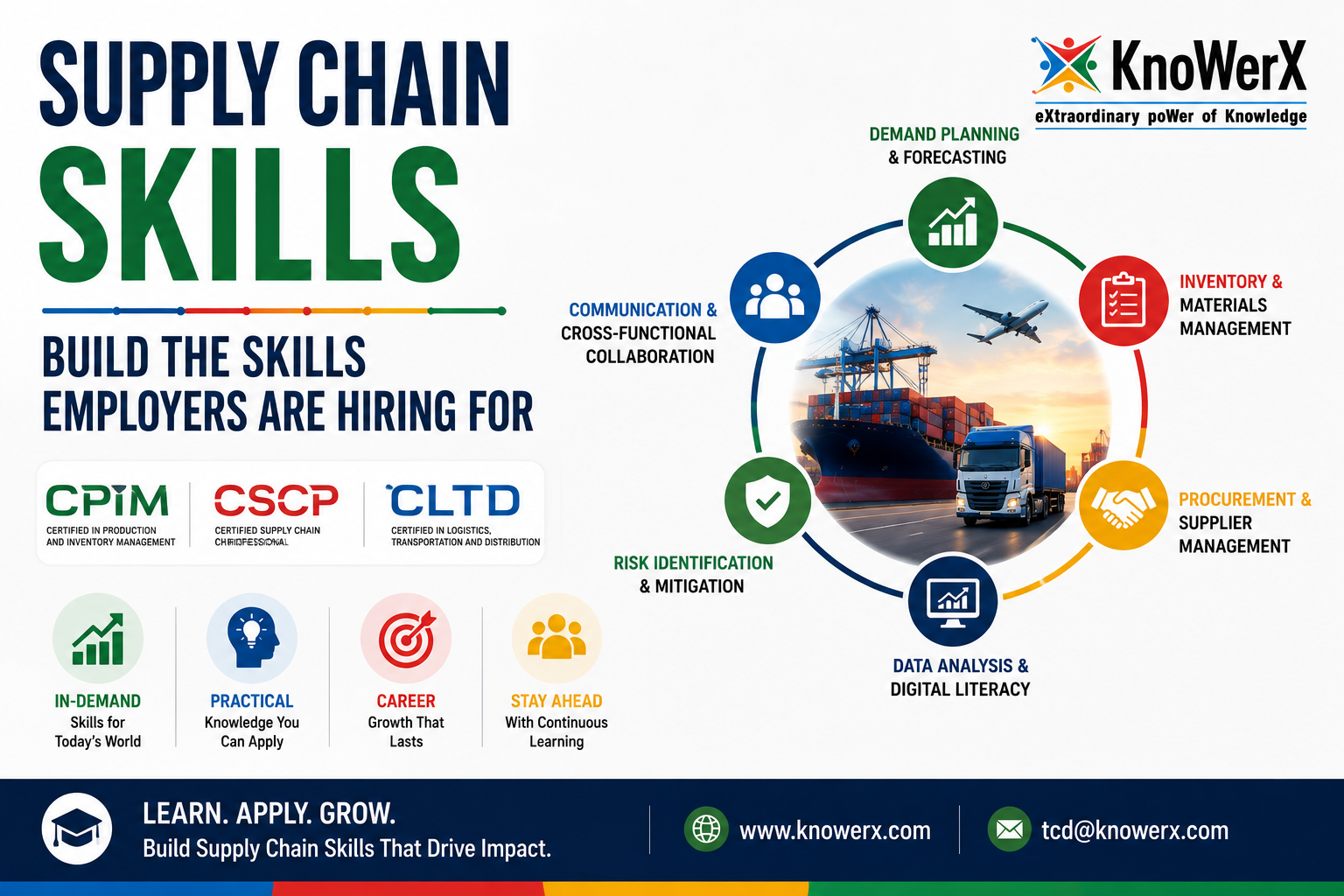
Demand Planning and Forecasting
The ability to interpret demand signals, apply appropriate forecasting methods, and translate outputs into actionable supply plans remains one of the most consistently sought-after supply chain skills. As markets become more volatile and customer expectations more precise, professionals who can produce reliable forecasts and adjust them dynamically are in high demand across industries.
Inventory and Materials Management
Inventory management sits at the operational core of most supply chains, and employers place significant value on professionals who understand replenishment methods, safety stock principles, and the trade-offs involved in balancing availability against carrying costs. These are supply chain skills that translate directly into measurable financial impact.
Procurement and Supplier Management
Strategic sourcing, supplier evaluation, contract management, and total cost of ownership analysis are procurement competencies that employers across manufacturing, retail, healthcare, and services consistently prioritise. The ability to manage supplier relationships effectively, particularly under conditions of supply uncertainty, has become one of the most valued supply chain skills in the current environment.
Data Analysis and Digital Literacy
Proficiency in data analysis tools, ERP systems, and supply chain planning platforms has moved from a desirable addition to a core expectation. Employers increasingly look for professionals who can extract meaningful insights from data, identify trends, and use digital tools to improve planning accuracy and operational efficiency. Supply chain skills in this area are particularly scarce, making them a strong differentiator for candidates who develop them.
Risk Identification and Mitigation
The ability to identify supply chain vulnerabilities, assess their potential impact, and develop mitigation strategies has become one of the most valued supply chain skills since global disruptions exposed just how fragile many supply chains were. Professionals who approach risk proactively rather than reactively add genuine strategic value to their organisations.
Essential Soft Skills That Differentiate Top Supply Chain Professionals
Technical skills are rarely what separates the great supply chain people from the good supply chain people. Key differentiators employers consistently mention are communication, cross-functional teamwork, and effective problem-solving in high-pressure situations.
Cross-functional collaboration is key. Supply chain decisions can impact finance, sales, operations, and procurement. The ability to navigate these relationships, influence stakeholders, and bring teams together around common goals is the skill set that allows professionals to advance most consistently in their careers.
Flexibility is also important. Supply chains function in fast-moving and often unpredictable environments. It is that resilience that employers see and reward – the ability to readjust priorities, recalibrate plans and still perform under pressure.
How to Build and Showcase Your Supply Chain Skills
Supply chain skills development is a combination of experience, formal learning and deliberate practice. Hands-on experience in planning, procurement or inventory roles provides the contextual grounding, while structured training and professional certification provide the framework for knowledge that is both current and credible.
ASCM’s certifications, including CPIM, CSCP and CLTD, are widely recognised by employers as proof of proven supply chain skills in the key functional areas. They demonstrate that the knowledge of a professional has been tested against an international benchmark, not just learned through experience.
Frequently Asked Questions
What are the most in-demand supply chain skills in 2026?
The most in-demand supply chain skills currently include demand planning and forecasting, inventory and materials management, procurement and supplier management, data analysis and digital literacy, and risk identification and mitigation. Soft skills such as cross-functional collaboration and adaptability are equally valued by employers.
What digital supply chain skills do employers look for?
Employers increasingly look for proficiency in ERP systems, supply chain planning platforms, and data analysis tools. The ability to extract meaningful insights from data, identify operational trends, and use digital tools to improve planning accuracy and efficiency is now a core expectation rather than a bonus.
How can I build supply chain skills recognised by employers?
A combination of hands-on experience in planning, procurement, or inventory roles, alongside structured training and professional certification, provides the strongest foundation. Certifications such as the CPIM, CSCP, and CLTD from ASCM are widely recognised by employers as evidence of validated supply chain competency.
Future-Proof Your Career With Continuous Learning
Supply chain skills are not static. The tools, frameworks, and best practices that define the profession continue to evolve, and professionals wh12o commit to continuous learning consistently outperform those who rely solely on past experience.
KnoWerX certification and training programmes are designed to help professionals develop the supply chain skills that employers are actively seeking. We combine expert instruction with practical, scenario-based learning that prepares candidates for real-world challenges and long-term career growth.
Image Reference: Magnific
Disclaimer: All trademarks, logos, and brand names are the property of their respective owners. All company, product, and service names used in this website are for identification purposes only. Use of these names, trademarks, and brands does not imply endorsement.