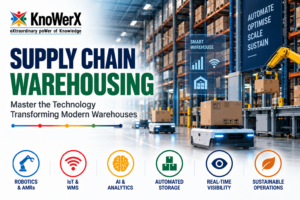
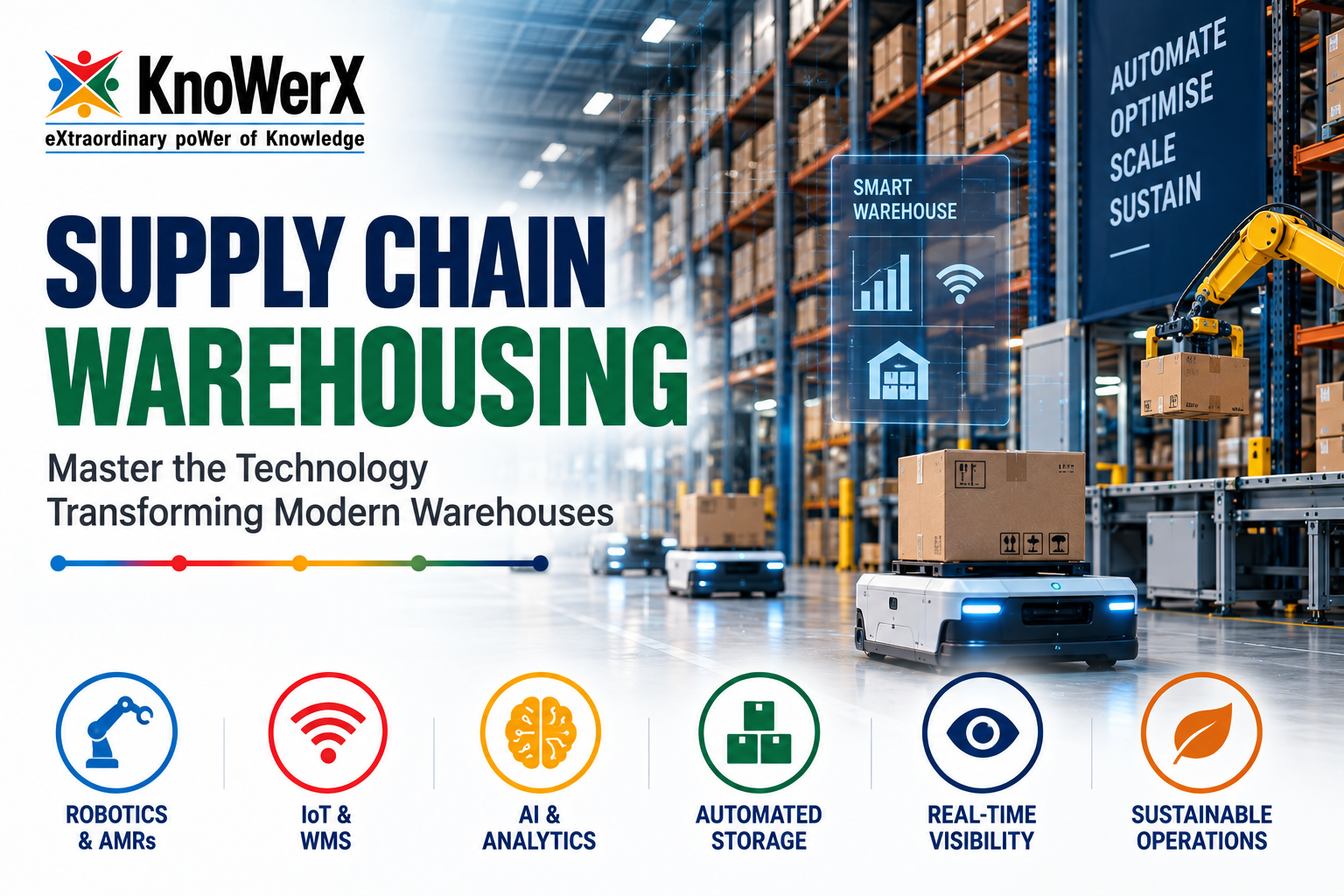
Supply Chain Warehousing | Master the Technology Transforming Modern Warehouses
“Warehousing has traditionally been viewed as one of the more operationally simple functions within supply chain management. That view is fast becoming outdated. 2026 is seeing one of the biggest changes in the history of the profession in supply chain warehousing as automation, artificial intelligence and real-time data are changing what warehouses do, how they do it and what it takes to manage them well.
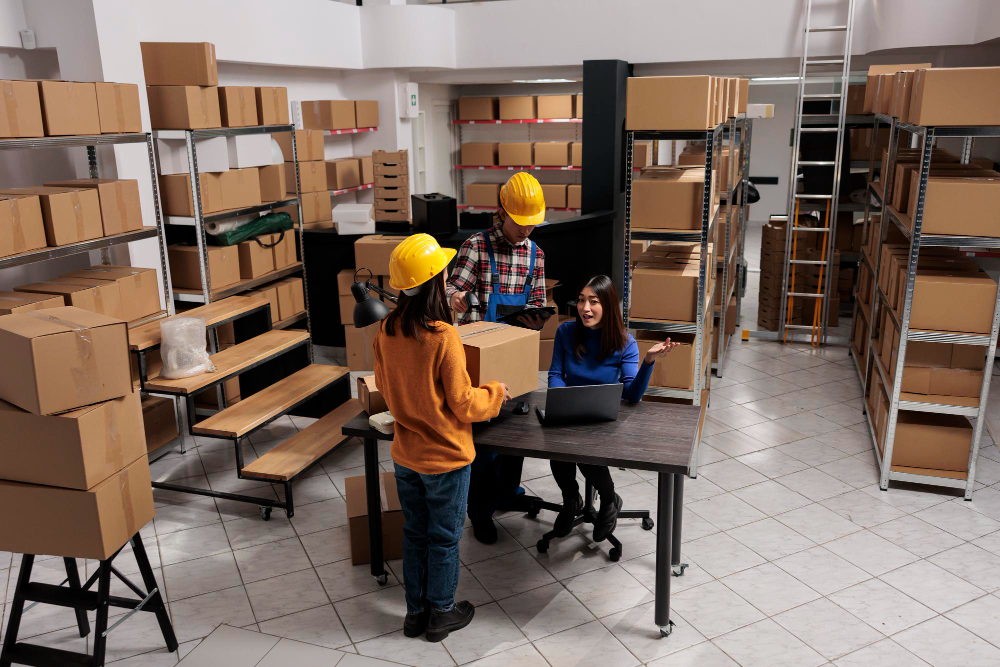
McKinsey says warehouse automation can improve productivity, fulfilment quality, safety, space utilisation and throughput. Newer systems are increasingly combining robotics with AI and computer vision to deliver results that were previously impossible.
How Technology Improves Supply Chain Warehousing Against Measurable Outcomes
The most effective way to evaluate technology in supply chain warehousing is against the specific operational challenges it addresses. The table below illustrates how leading technologies map to common warehousing challenges and the measurable outcomes they deliver:
| Warehouse Challenge | Technology Solution | Potential Impact |
| Manual picking | Robotics and AMRs | Higher productivity |
| Inventory inaccuracies | IoT and WMS | Better inventory visibility |
| Slow decisions | AI and analytics | Faster response |
| Space constraints | Automated storage | Better space utilisation |
| Labour-intensive processes | Automation | Reduced manual workload |
| Poor visibility | Real-time tracking | Better control |
Robotics and Autonomous Mobile Robots
Manual picking is one of the most time-consuming and error-prone activities in supply chain warehousing. Robotics and autonomous mobile robots are transforming this function by navigating warehouse floors independently, transporting goods between locations, and working alongside human operators to increase throughput and reduce travel time. Unlike fixed automated systems, AMRs are flexible and scalable, adapting to changing layouts and operational priorities whilst delivering consistently higher productivity than manual alternatives.
IoT and Warehouse Management Systems
Inventory inaccuracies are amongst the most costly problems in supply chain warehousing, leading to stockouts, overstocking, and fulfilment errors that erode customer trust. IoT sensors combined with modern warehouse management systems provide real-time visibility into stock locations, quantities, and conditions across the entire facility, eliminating the blind spots that cause inaccuracies to develop and persist.
AI and Advanced Analytics
Slow decision-making is a significant operational liability in fast-moving supply chain warehousing environments. AI and advanced analytics address this by providing warehouse managers with real-time performance data, predictive insights, and automated recommendations that enable faster, more informed responses to changing conditions. AI-powered slotting optimisation continuously recalculates product locations based on live demand data, ensuring warehouse layouts remain efficient as demand patterns evolve.
Automated Storage and Retrieval Systems
Space constraints are a persistent challenge in supply chain warehousing, particularly as organisations seek to hold more SKUs without expanding their physical footprint. Automated storage and retrieval systems enable high-density storage configurations that maximise space utilisation whilst reducing the time required to locate and retrieve items for order fulfilment, making better use of existing facilities before committing to costly expansions.
Real-Time Tracking and Visibility Platforms
Poor visibility into supply chain warehousing operations results in reactive management, missed SLAs and an inability to identify and resolve issues before they impact customers. Real-time tracking platforms, enabled by IoT sensors and integrated with warehouse management systems, provide continuous visibility of inventory locations, order status, equipment utilisation and labour performance, giving warehouse managers the control they need to run proactive, high-performance operations.
Computer Vision and Quality Control
Computer vision technology is transforming quality control in supply chain warehousing. Automated visual inspection systems assess products, packaging, and labels at speeds and accuracy levels that exceed manual inspection, detecting damage, mislabelling, and defects before goods are dispatched. As McKinsey highlights, newer systems increasingly combine robotics with AI and computer vision to deliver compound improvements across productivity, quality, and safety simultaneously.
Sustainability in Supply Chain Warehousing
Technology is also driving measurable progress on sustainability within supply chain warehousing. Energy management systems optimise lighting, heating, and cooling based on occupancy and activity levels, whilst route optimisation tools reduce unnecessary movement within the facility. Reverse logistics platforms make it easier to manage returned goods efficiently, recovering value from returns and reducing waste in line with growing circular economy expectations from customers, regulators, and investors.
Frequently Asked Questions
How is technology transforming supply chain warehousing?
Technology is reshaping supply chain warehousing across every dimension — from AI-driven predictive analytics and autonomous mobile robots to IoT environmental monitoring, computer vision quality control, and cloud-based warehouse management systems that provide real-time visibility across the entire facility.
How does AI improve supply chain warehousing operations?
AI improves supply chain warehousing through predictive analytics that anticipate future activity levels, enabling proactive labour and equipment allocation. AI-powered slotting optimisation continuously recalculates product locations based on live demand data, ensuring warehouse layouts remain efficient as demand patterns evolve throughout the year.
How is computer vision being used in supply chain warehousing?
Computer vision systems automate quality inspection in supply chain warehousing, detecting product damage, mislabelling, and packaging defects at speeds and accuracy levels that exceed manual inspection. This reduces defective deliveries, improves customer satisfaction, and provides a scalable quality assurance process that does not depend on individual inspector performance.
Ending Notes – Building Warehouse Management Expertise for a Technology-Driven Future
Understanding how technology is reshaping supply chain warehousing is valuable. Being able to manage, evaluate, and lead within technology-enabled warehouse environments is what actually delivers competitive advantage for both professionals and the organisations they work for.
KnoWerX’s supply chain training programmes help warehousing and logistics professionals to gain the knowledge and credentials to be effective in today’s technology-driven supply chain warehousing environments. We are ASCM’s Premier Elite Partner with 34 years of supply chain education excellence and are dedicated to making sure every professional we train is ready not just for today’s warehouses but for the ones that are quickly coming together. If you’re ready to build your supply chain warehousing expertise, we’d love to help you on your journey.
Image Reference: Magnific
Disclaimer: All trademarks, logos, and brand names are the property of their respective owners. All company, product, and service names used in this website are for identification purposes only. Use of these names, trademarks, and brands does not imply endorsement.