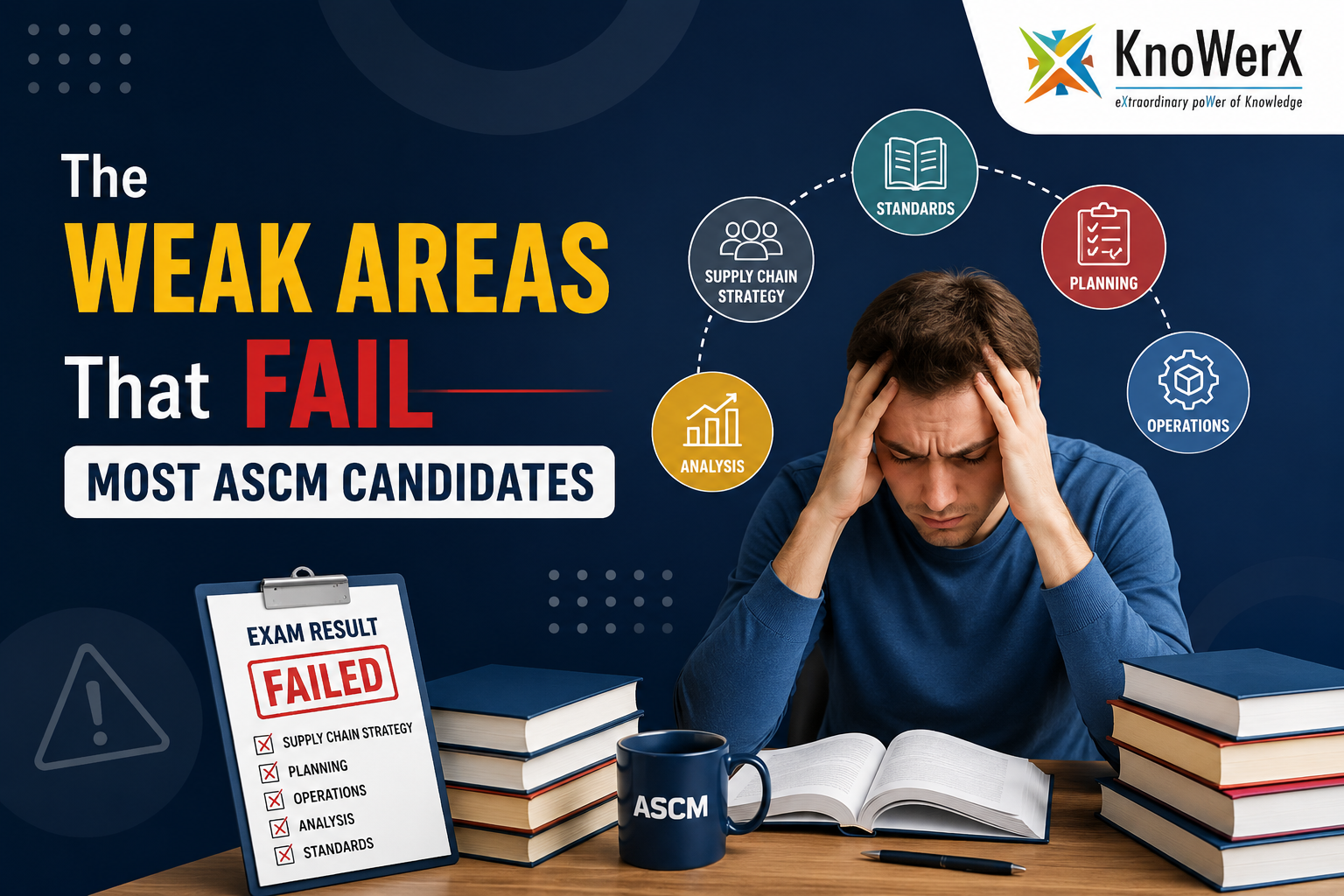
The Weak Areas That Fail Most ASCM Candidates | KnoWerX
Most candidates who fall short on their ASCM certification exam are not failing because they did not study. They are failing because of a handful of recurring weak areas that go unaddressed throughout their preparation.

Understanding what these weak areas typically are, and how to deal with them before exam day, can be the difference between a pass and a disappointing retake.
The Most Common Weak Areas in Supply Chain Certification Exams
Demand Forecasting and Variability
Forecasting concepts are frequently misunderstood at an applied level. Candidates often grasp the theory behind forecasting models but struggle when exam questions require them to interpret variability, select an appropriate forecasting method for a given scenario, or reconcile forecasts with actual demand signals.
Inventory Management Calculations
Topics involving safety stock, reorder points, and inventory replenishment methods are consistently challenging. These areas combine conceptual understanding with numerical calculation, and candidates who are comfortable with the theory often falter when a question requires them to work through the maths under time pressure.
Procurement and Supplier Relationship Concepts
Procurement strategy, particularly around supplier selection criteria, total cost of ownership, and sourcing decisions, is another recurring weak spot. These topics often involve nuanced trade-offs rather than clear-cut answers, which candidates accustomed to more straightforward content can find unsettling.
Integrated, Cross-Module Scenarios
Perhaps the most consistently difficult area is questions that draw on multiple modules simultaneously. A scenario might require knowledge of forecasting, inventory, and supplier management all at once. Candidates who study modules in isolation, without practising integration, often find this question style unexpectedly challenging.
How Weak Areas Impact Exam Performance
A Few Weak Modules Can Undermine an Otherwise Strong Score
ASCM exams are weighted across multiple content areas, so candidates cannot simply excel in their favourite topics and make up for the rest. Persistent weakness in even one or two areas can be enough to bring an otherwise strong overall score below the passing threshold.
Weak Areas Create Hesitation and Time Pressure
Beyond the direct impact on scoring, weak areas slow candidates down during the exam itself. Uncertainty breeds hesitation, and candidates who linger too long on questions in their weaker topics often find themselves rushing through the remainder of the exam, increasing the likelihood of careless errors elsewhere.
How to Identify and Improve Supply Chain Exam Weak Areas
Use Practice Test Results as Diagnostic Data
The most reliable way to identify weak areas is through regular practice testing. Rather than viewing practice scores purely as pass or fail indicators, break results down by topic area to see precisely where performance consistently dips. This data-driven approach removes guesswork from your revision planning.
Revisit the Exam Content Outline
Cross-reference your weak areas against the official exam content outline to understand how heavily each weighs in the actual exam. This helps prioritise revision time on weak areas that carry significant weight, rather than spreading effort evenly across all topics.
Seek Targeted Clarification
Once a weak area is identified, passive re-reading rarely resolves it. Seeking instructor-led explanation, peer discussion, or supplementary resources focused specifically on that topic tends to close the gap far more effectively than repeating the same study method that did not work the first time.
Common Preparation Mistakes That Lead to Failure
Avoiding Difficult Topics Instead of Confronting Them
It is natural to spend more time on topics that feel comfortable. Unfortunately, this instinct means weak areas often receive the least attention, precisely when they need the most.
Treating All Topics With Equal Time Allocation
Conversely, some candidates spread their study time evenly without considering the weighting of the exam content outline or their performance data, resulting in inefficient use of limited preparation time.
Failing to Revisit Weak Areas Closer to the Exam
Weak areas addressed early in preparation can fade again by exam day if not revisited. Without scheduled review cycles, earlier progress on a difficult topic can quietly erode over the following weeks.
Strategies to Turn Weak Areas into Strengths
Build Dedicated Weak-Area Study Blocks
Rather than folding weak topics into general review, schedule dedicated study sessions specifically targeting them. Treating these areas with intentional focus, rather than incidental coverage, produces measurably better results.
Practice With Scenario and Integration Questions
Since cross-module scenarios are among the most commonly cited weak areas, deliberately practising integrated questions in the final weeks of preparation helps build the synthesis skills that these questions require.
Frequently Asked Questions
Why do candidates fail ASCM certification exams even after studying?
Many candidates fail not due to lack of preparation, but because they leave key weak areas unaddressed. Topics like forecasting, inventory calculations, and scenario-based questions often create confusion under exam pressure. Without targeted practice and revision, these weak areas can significantly lower overall scores.
How can I improve my weak areas for ASCM exam preparation?
You can improve weak areas by analyzing practice test results, focusing on topic-specific revision, revisiting the official exam content outline, and practicing scenario-based questions. Consistent review and targeted study sessions help convert weak topics into strong scoring areas over time.
Ending Notes – Track Improvement Over Time
Re-test weak areas periodically rather than assuming a single round of focused study has resolved the gap. Tracking improvement gives candidates confidence that their effort is translating into genuine readiness, not just a temporary boost.
Every ASCM candidate has weak areas, but the candidates who pass are the ones who identify theirs honestly and address them deliberately. At KnoWerX, our instructor-led training is built around exactly this principle, helping candidates pinpoint their specific weak areas and turn them into genuine strengths well before exam day.
Image Reference: Magnific
Disclaimer: All trademarks, logos, and brand names are the property of their respective owners. All company, product, and service names used in this website are for identification purposes only. Use of these names, trademarks, and brands does not imply endorsement.