5 C’s of Supply Chain Management | Master SCM Excellence | KnoWerX
Supply chain management frameworks appear and disappear, but the ones that last are the ones that reflect something fundamentally true about how successful supply chains work. This kind of enduring clarity is provided by the 5 C’s of supply chain management, Connect, Create, Customise, Collaborate and Contribute.

They offer a practical perspective for supply chain professionals to gauge the degree of alignment of their operations with the needs of the modern business environment and identify where the greatest opportunities for improvement lie.
Why the 5 C’s Matter in Modern Supply Chain Management
Supply chains that succeed in 2026 will need to: meet growing customer expectations, operate within tight cost parameters, provide end-to-end visibility, manage increasingly complex supplier relationships, and show credible progress on sustainability. Meeting these demands is not simply about achieving operational efficiency, but about having a strategic framework that links every supply chain decision to the outcomes that matter most to the business and its customers.
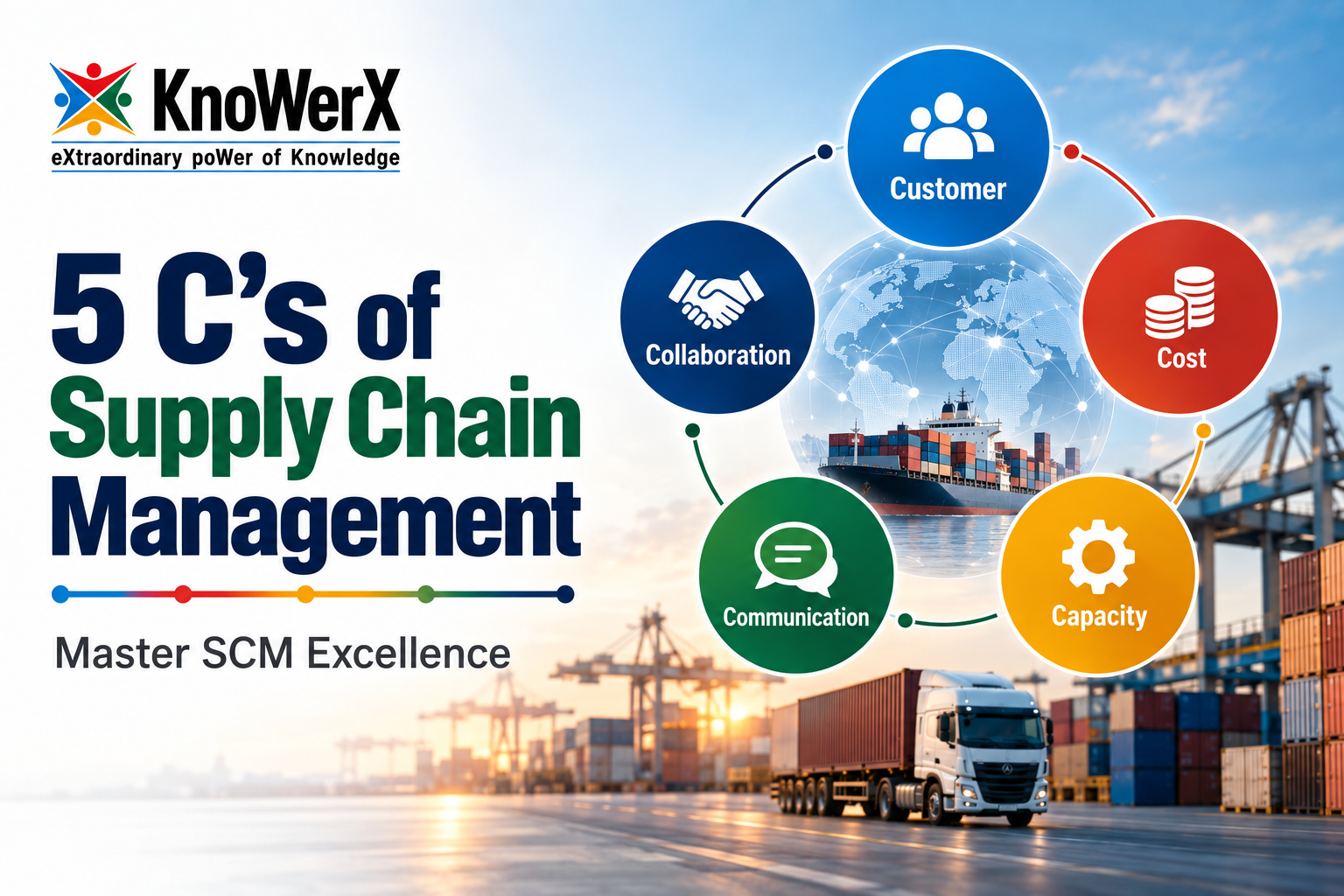
That’s where the 5 C’s of supply chain management come in. They provide a framework for supply chain professionals to ensure customer expectations and operational capacity, cost efficiency and service excellence, and internal execution and external collaboration are all aligned. Each C tackles an aspect of supply chain performance that organisations are consistently challenged to optimise in isolation, and together they form a comprehensive view of what supply chain excellence actually looks like in practice.
Customer
The customer is the starting point for every supply chain decision. Customer expectations around delivery speed, order accuracy, product availability, and sustainability credentials are rising consistently across industries, and supply chains that are designed around internal operational convenience rather than customer outcomes consistently underperform on the metrics that matter most to the business.
The 5 C’s framework starts with customer. In supply chain management today, this framework links everything downstream from inventory positioning and supplier selection to transportation routing and returns management to the things customers value. The foundation of supply chain excellence is to understand what customers expect, how those expectations are changing and how the supply chain can be organised to meet them more reliably.
Cost
Cost efficiency remains one of the most important dimensions of supply chain performance, but the 5 C’s framework places cost as one consideration among many, rather than the primary driver of every decision. Supply chains optimised solely for cost through single-source supplier strategies, minimal safety stock, and the longest possible payment terms have repeatedly demonstrated their fragility when disruption strikes.
The 5 C’s of supply chain management approach cost through the lens of total value rather than unit price, encouraging professionals to consider the full cost implications of supply chain decisions across inventory carrying costs, risk exposure, service level impacts, and long-term supplier relationship value. This broader view of cost is increasingly aligned with how senior business leaders evaluate supply chain performance.
Capacity
Operational capacity the ability of the supply chain to meet demand reliably under both normal and disrupted conditions is the third of the 5 C’s of supply chain management. Capacity planning encompasses production capacity, supplier capacity, warehouse throughput, and transportation availability, and it must be managed dynamically as demand patterns shift and supply conditions change.
Today, capacity management is becoming much more sophisticated in supply chains through digital transformation and AI-driven planning tools, allowing organisations to model capacity constraints across their entire network in real time and identify bottlenecks before they impact service levels. Supply chain resilience is one of the defining priorities of 2026. Fundamentally, supply chain resilience needs enough capacity visibility and flexibility to absorb the hit without service failures.
Communication
The fourth of the 5 C’s of supply chain management is effective communication across the supply chain between functions, between organisations and between systems and it is one of the most consistently under invested. Demand signals don’t reach planning in time to modify due to poor sales and operations communication. Procurement and suppliers not communicating effectively can lead to lead time surprises that should have been anticipated and managed.
Technology such as end-to-end visibility platforms, integrated data ecosystems and real-time tracking tools enable better supply chain communication, but technology alone is not enough. Equally important are the cultural and organisational practices that deliver relevant information to the right people at the right time, and require deliberate investment in both process design and people capability.
Collaboration
Collaboration is the fifth of the 5 C’s of supply chain management and is the one that most directly addresses the extended supply chain, the network of suppliers, logistics providers, distributors and customers whose combined performance determines the outcomes that any single organisation can deliver. Consistently, supply chains that are collections of independently optimised functions perform worse than supply chains that are genuinely collaborative networks.
Supplier collaboration, in particular, has emerged as a critical supply chain priority in 2026. Organisations that share demand data with key suppliers, involve them early in new product development, and work collaboratively on risk management and sustainability improvement consistently achieve better outcomes across cost, quality, and resilience than those that manage supplier relationships at arm’s length through transactional procurement processes alone.
Frequently Asked Questions
What are the 5 C's of supply chain management?
The 5 C's of supply chain management are Customer, Cost, Capacity, Communication, and Collaboration. Together they provide a practical framework for evaluating and improving supply chain performance across the dimensions that matter most to business outcomes and customer satisfaction.
Why do the 5 C's of supply chain management matter in 2026?
Modern supply chains must simultaneously meet rising customer expectations, manage costs efficiently, maintain operational capacity, enable end-to-end communication, and drive supplier collaboration. The 5 C's framework connects these priorities into a coherent approach to supply chain excellence that addresses both operational and strategic performance.
How do the 5 C's of supply chain management relate to sustainability?
Sustainability performance connects directly to Customer — as customers increasingly expect responsible supply chains — Cost — through total value thinking that accounts for environmental and social impacts — and Collaboration — through supplier engagement programmes that drive sustainability improvement across the extended supply chain.
Ending Notes – Connecting the 5 C’s to Current SCM Priorities
The 5 C’s of supply chain management are not an abstract framework they connect directly to the priorities that are defining supply chain leadership in 2026. Supply chain resilience depends on capacity visibility and supplier collaboration. Digital transformation enables better communication and data-driven decision-making across all five dimensions. Sustainability performance is improved through customer alignment, cost transparency, and collaborative supplier engagement. Risk management is strengthened when organisations balance customer expectations, operational capacity, and communication across their entire network simultaneously.
At KnoWerX, we help supply chain professionals build the knowledge and practical frameworks needed to apply principles like the 5 C’s of supply chain management effectively in their organisations. As ASCM’s Premier Elite Partner with 34 years of supply chain education excellence, our programmes are designed to connect strategic frameworks to real operational challenges giving candidates the depth of understanding that drives genuine career and business impact.
Image Reference: Magnific
Disclaimer: All trademarks, logos, and brand names are the property of their respective owners. All company, product, and service names used in this website are for identification purposes only. Use of these names, trademarks, and brands does not imply endorsement.