How Professionals Can Transition into Supply Chain Careers
Supply chain careers are among the fastest-growing professional pathways globally. As organisations invest in supply chain resilience, digital transformation, and operational efficiency, the demand for skilled supply chain professionals continues to outpace the supply. For career changers, the current situation creates a significant and well-timed opportunity.

Whether you come from finance, operations, customer service, retail, or manufacturing, a transition into supply chain careers is more achievable than most professionals realise, particularly when approached with the right strategy.
Transferable Skills That Help You Move Into Supply Chain Careers
One of the most encouraging aspects of transitioning into supply chain is how many skills from other fields apply directly.
Professionals with a background in finance or accounting bring strong analytical thinking, cost management awareness, and comfort with data, all of which are essential for roles involving procurement, demand planning, and inventory optimisation.
Those from operations or manufacturing already understand process flows, capacity constraints, and quality management, which translate naturally into production planning and materials management functions.
Customer service and sales professionals bring demand-side awareness, stakeholder communication skills, and an understanding of how delivery performance affects customer satisfaction a perspective highly valued in order management and logistics coordination roles.
Project management experience is directly applicable to supply chain improvement initiatives, supplier onboarding, and system implementation projects.
The key is to identify where your existing skills map to supply chain functions and position that alignment clearly when applying for roles.
Best Entry-Level Roles for Career Changers in Supply Chain
Supply Chain Analyst – This role focuses on collecting, interpreting, and reporting supply chain data to support decision-making. It is an excellent entry point for professionals with strong analytical or financial backgrounds.
Procurement Coordinator – Procurement coordinators manage supplier communications, raise purchase orders, and support contract administration. Professionals from administrative, finance, or vendor management backgrounds adapt well to this role.
Inventory Planner – Inventory planners monitor stock levels, calculate replenishment needs, and work to balance availability with carrying costs. Attention to detail and comfort with data make this role a strong fit for career changers from retail or operations.
Logistics Executive – This role coordinates the movement of goods across carriers, freight forwarders, and internal teams. Communication skills, problem-solving ability, and process discipline are the core requirements making it accessible to professionals from a range of backgrounds.
Demand Planning Associate – Demand planning associates support the forecasting process by gathering sales data, identifying trends, and updating planning models. This role suits professionals with analytical skills and an understanding of commercial or market dynamics.
Certifications That Accelerate Supply Chain Career Transitions
For career changers, certifications serve a dual purpose they build knowledge and signal credibility to employers who may be unfamiliar with your background.
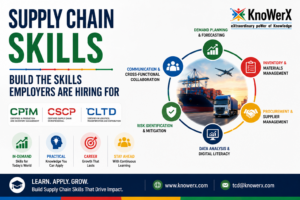
ASCM CPIM (Certified in Planning and Inventory Management) is widely regarded as the foundational certification for supply chain professionals. It covers production planning, inventory control, and demand management building exactly the knowledge base needed for most entry-level and mid-level supply chain roles.
ASCM CSCP (Certified Supply Chain Professional) provides a broader end-to-end view of the supply chain and is particularly valuable for professionals targeting roles in supply chain strategy, S&OP, or cross-functional coordination.
ASCM CLTD (Certified in Logistics, Transportation and Distribution) is ideal for those moving into logistics, warehousing, or distribution functions.
These certifications demonstrate to employers that a career changer has made a serious commitment to the field and has acquired the domain knowledge needed to contribute effectively from day one.
Skills Employers Look for in Modern Supply Chain Careers
Beyond functional knowledge, employers hiring for modern supply chain careers consistently look for the following capabilities:
ERP / SAP / Oracle Familiarity — Most supply chain operations run on enterprise systems. Familiarity with ERP platforms, even at a user level, significantly improves employability.
Forecasting and Planning — Almost every supply chain function values the ability to analyse historical data, build demand models, and support planning cycles.
Data Analytics — Proficiency in Excel, and increasingly in tools like Power BI or Python, helps professionals extract insights from supply chain data and support informed decision-making.
Supply Chain Resilience — Employers want professionals who understand risk, can identify vulnerabilities, and contribute to contingency planning and business continuity.
Risk Management — The ability to evaluate supplier risk, assess geographic exposure, and develop mitigation strategies is increasingly essential in today’s volatile trade environment.
Step-by-Step Roadmap to Transition Into Supply Chain Careers
Step 1 — Audit your transferable skills. Map your current experience against supply chain functions to identify where your background adds immediate value.
Step 2 — Choose your entry point. Based on your skills and interests, identify the most natural entry-level role and focus your job search accordingly.
Step 3 — Enrol in a recognised certification. Start with CPIM or CSCP to build structured supply chain knowledge and strengthen your resume with a credible credential.
Step 4 — Build ERP and data familiarity. Take online courses in SAP, Oracle, or Excel-based supply chain analytics to close common skill gaps employers look for.
Step 5 — Network within the supply chain community. Connect with supply chain professionals on LinkedIn, attend industry events, and engage with associations like ASCM to build awareness and access to opportunities.
Step 6 — Apply with a targeted narrative. Frame your career change confidently highlighting your transferable skills, your certification progress, and your motivation for moving into supply chain.
Frequently Asked Questions
Can I transition into supply chain careers without prior experience?
Yes. Many supply chain roles value transferable skills from fields such as finance, operations, customer service, and project management. Pairing your existing experience with a recognised certification like ASCM CPIM significantly improves your chances of securing an entry-level supply chain role.
What are the best entry-level roles for career changers in supply chain?
The most accessible entry-level roles for career changers include Supply Chain Analyst, Procurement Coordinator, Inventory Planner, Logistics Executive, and Demand Planning Associate — each suited to different professional backgrounds and skill sets.
Which certification is best for professionals transitioning into supply chain?
The ASCM CPIM is widely recommended as the starting point for career changers, as it builds foundational knowledge in planning, inventory, and demand management. Those targeting broader strategic roles may also consider the ASCM CSCP for a more comprehensive end-to-end supply chain perspective.
Ending Notes

Transitioning into supply chain careers is not just possible it is increasingly common as the field expands and diversifies. The professionals who move successfully are those who invest in the right knowledge, position their existing strengths clearly, and pursue globally recognised certifications to bridge the credibility gap.
At KnoWerX, we support professionals at every stage of their supply chain journey including those making the transition from other fields with globally aligned certification programmes and expert guidance built around real-world career outcomes.
Image Reference: Freepik
Disclaimer: All trademarks, logos, and brand names are the property of their respective owners. All company, product, and service names used in this website are for identification purposes only. Use of these names, trademarks, and brands does not imply endorsement.