Role of Distribution Manager | Master SCM Leadership Skills | KnoWerX
Supply chains do not end when a product leaves the factory floor. Getting the right goods to the right place at the right time, in the right condition and quantity, is a challenge that sits squarely with the distribution manager.

In supply chain management, this role is the operational backbone of the outbound supply chain, connecting production with the end customer through a complex web of warehousing, transportation, and logistics coordination.
Understanding the Role of a Distribution Manager in Supply Chain Management
The distribution manager role is where logistics, operations and customer service intersect. Distribution managers are responsible for managing the shipment of finished products from storage to their final destination, which may be a retail store, a business customer or a consumer. They efficiently and reliably manage the people, processes, systems and infrastructure that enable this movement.
The role of distribution manager in the modern supply chain management has grown significantly in importance of strategy. With the increasing customer expectations about delivery speed and accuracy, and the increasing globalisation and complexity of supply chains, the ability to effectively manage distribution operations has become a true competitive differentiator for businesses in any industry.
Key Responsibilities of a Distribution Manager
A distribution manager’s day-to-day work covers a wide range of various operational and strategic tasks. This includes managing warehouse operations, managing inbound and outbound shipments, liaising with transport providers and ensuring that order fulfilment targets are consistently achieved at operational level.
Distribution managers have strategic responsibility for the optimisation of distribution network design, management of third party logistics provider relationships, distribution cost management and health, safety and regulatory compliance. They also play a critical role in inventory management in the distribution network, balancing stock availability against the cost of excess inventory at multiple locations.
The role is just as much about performance monitoring. Distribution managers monitor performance indicators such as order fulfilment rates, order accuracy, warehouse capacity, and transportation expenses. They analyse data to pinpoint operational inefficiencies and strive for ongoing enhancements in their distribution processes.
Essential Skills Required to Excel in the Role of Distribution Manager
Leadership and People Management
Distribution operations involve large, often shift-based teams working across warehouses, loading docks, and transport functions. The ability to lead, motivate, and develop people across these environments is fundamental to the role of distribution manager. Strong people management skills directly influence team performance, retention, and operational consistency.
Analytical and Problem-Solving Ability
Distribution managers work with significant volumes of operational data. The ability to interpret this data, identify trends, diagnose problems, and implement effective solutions quickly is essential, particularly in fast-moving environments where delays in decision-making can have immediate knock-on effects across the supply chain.
Supply Chain and Logistics Knowledge
A thorough understanding of supply chain principles, logistics operations, and distribution network design underpins effective performance in this role. Distribution managers who understand how their function connects to upstream planning, procurement, and inventory management are better positioned to make decisions that benefit the wider supply chain rather than optimising distribution in isolation.
Technology Proficiency
Warehouse management systems, transport management systems, and ERP platforms are central tools in modern distribution operations. Proficiency in these systems, and the ability to leverage data from them for operational decision-making, is increasingly non-negotiable for anyone in the role of distribution manager.
Why the Role of Distribution Manager Is Critical to Business Success
The distribution function is often the last point of contact between a business and its customer. Errors at this stage, whether late deliveries, incorrect orders, or damaged goods, directly affect customer satisfaction and brand reputation in a way that upstream supply chain failures typically do not.
Beyond customer experience, distribution costs represent a significant proportion of total supply chain expenditure for most businesses. A skilled distribution manager who can reduce transportation costs, improve warehouse efficiency, and optimise stock positioning across the network delivers measurable financial value to the organisation.
Career Opportunities and How to Become a Distribution Manager
Distribution managers are sought after in a wide range of industries, including retail, manufacturing, healthcare, e-commerce and third-party logistics. Typical career paths start with a warehouse supervisor or logistics coordinator, advance to distribution manager, and finally to senior supply chain leadership roles.
Frequently Asked Questions
What is the role of a distribution manager in supply chain management?
A distribution manager oversees the movement of finished goods from storage facilities to their final destination. They manage warehousing, transportation, order fulfilment, logistics coordination, and distribution network performance across the outbound supply chain.
What are the key responsibilities of a distribution manager?
Key responsibilities include managing warehouse operations, coordinating inbound and outbound shipments, overseeing third-party logistics providers, controlling distribution costs, monitoring performance metrics, and ensuring compliance with health, safety, and regulatory requirements.
What skills are essential for a distribution manager?
Essential skills include leadership and people management, analytical and problem-solving ability, supply chain and logistics knowledge, and proficiency in warehouse management systems, transport management systems, and ERP platforms.
Ending Notes
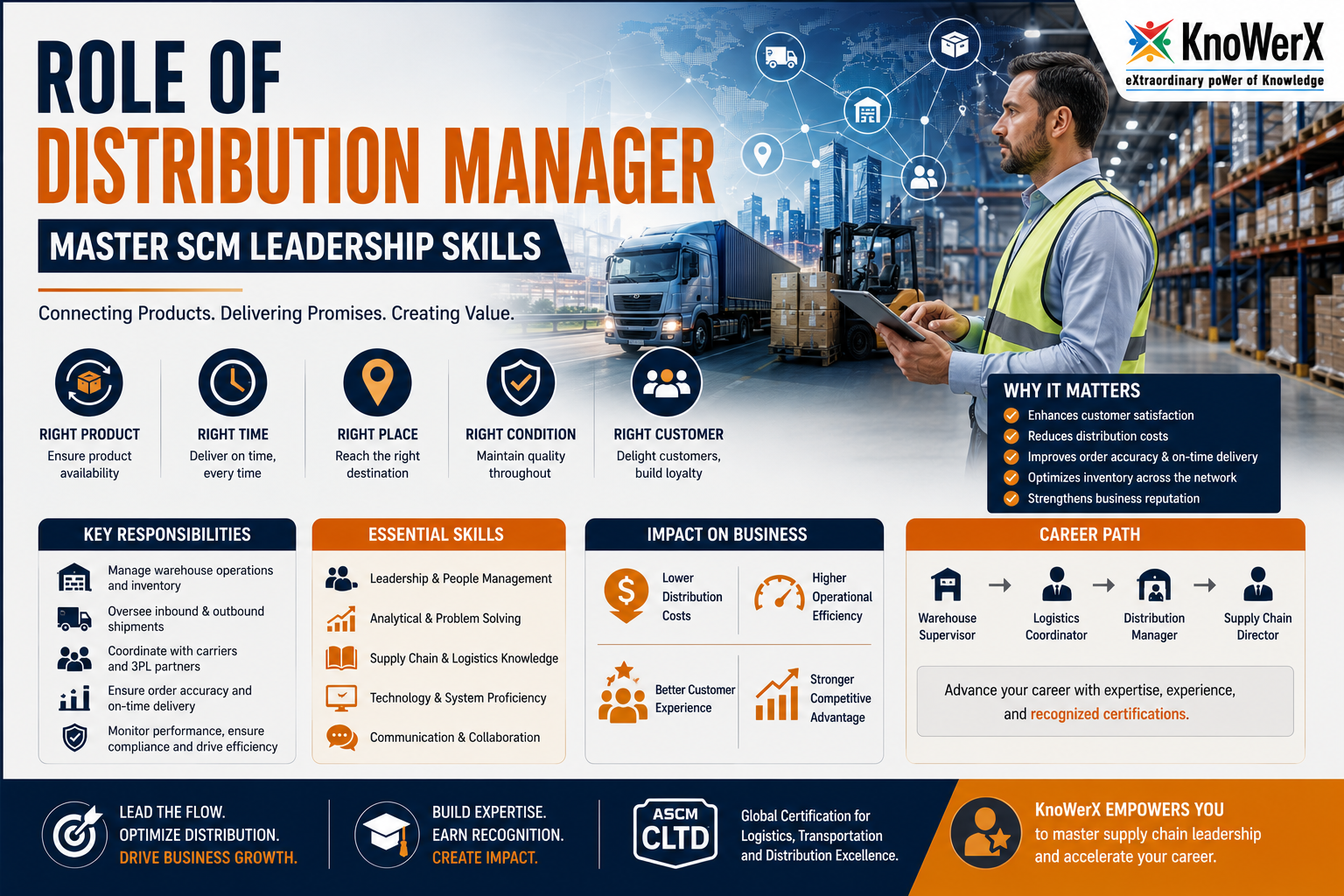
Combining operational experience with a recognised supply chain certification enhances the knowledge base and professional credibility needed to grow in this field. Certifications such as ASCM’s CLTD are particularly relevant, offering deep dives into logistics, transportation and distribution management.
At KnoWerX, our supply chain training programmes are designed to equip professionals with the skills and knowledge they need to excel in roles such as distribution manager and build long-term careers in supply chain management.
Image Reference: Magnific
Disclaimer: All trademarks, logos, and brand names are the property of their respective owners. All company, product, and service names used in this website are for identification purposes only. Use of these names, trademarks, and brands does not imply endorsement.